There is a line painted on the ground here. It runs across a courtyard, up a brass strip in the cobblestones, and disappears into the horizon in both directions. Stand on it and you are standing on Longitude Zero, the meridian from which every time zone on earth is measured. Every scheduled flight, every shipping route, every clock on every phone in the world is calibrated to this particular strip of brass on a hill in south-east London.
One foot east. One foot west.
Five miles from the centre of London and feeling nothing like it. A riverside neighbourhood with a Royal Park, a UNESCO World Heritage Site, a Victorian market, pubs that have been pouring since the 1830s, and streets lined with Georgian townhouses that have barely changed since they were built.
Greenwich is the kind of place that surprises people who think they know what London looks like, because it doesn't look like London at all. It looks like itself.
What makes it worth the journey
Few places in London carry this much history in this small a space.
A royal palace stood here before the Tudor monarchs were born in it.
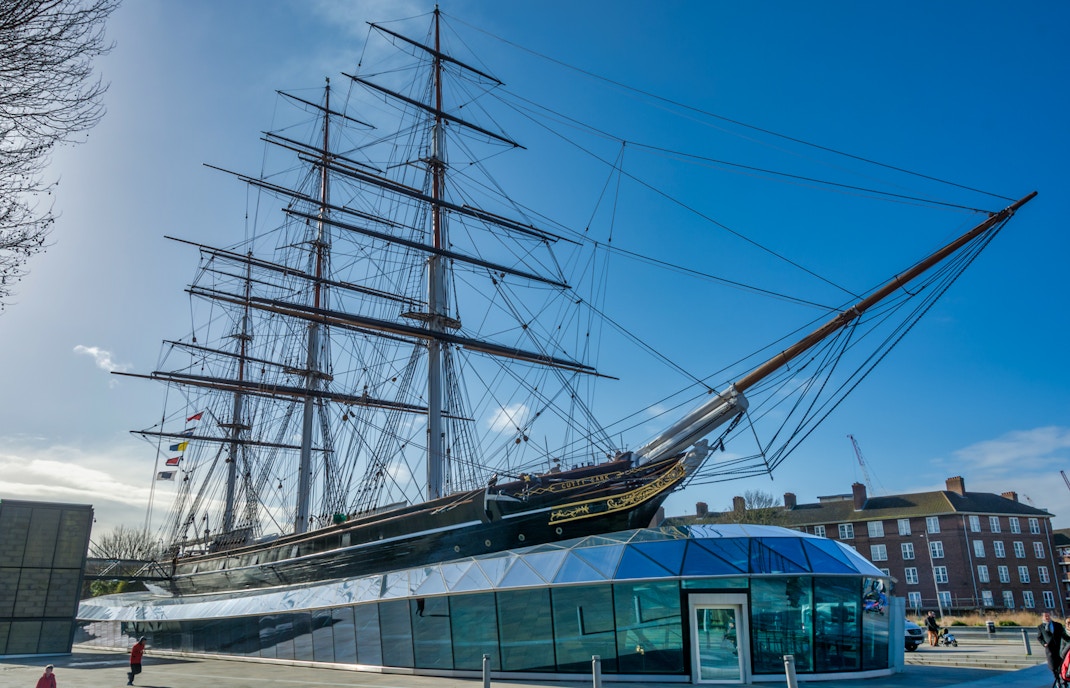
The ship that won the great tea races of the Victorian era is preserved in the same dock where she was brought home.
The room where Nelson lay in state before his funeral at St Paul's is open to anyone who walks through the door.
What makes Greenwich different from other historic sites is that none of it has been sanitised into a theme park. The buildings are still used. The streets are still lived on.
The pub Dickens frequented still serves the same dish it always did, on the same stretch of river.
And almost all of it is free to enter.
The story of Greenwich
Greenwich is a place where history unfolds across centuries. From Roman settlers on the hill to Tudor kings by the river, from sailors returning from distant seas to astronomers mapping the stars, every corner tells a story.
Walk from the river to the hilltop and follow the paths that shaped England’s power, innovation, and the way the world measures time.
The geography that drew people
Greenwich sits on a bend of the Thames where the land rises sharply, giving clear views upstream toward London, downstream to the sea, and across the marshes of the north bank. For centuries, its position made it visible from afar and a natural place to settle.
The Romans saw its value, building a villa on the hill and a temple by the river. Later, the Saxons arrived, calling it Gronewic, the green village. They farmed the land, fished the river, and buried their dead on the hill that had long been recognised as strategically important. The road they laid along the river still runs beneath Greenwich’s streets today.
The riversides and royal residences
By the early 15th century, Humphrey, Duke of Gloucester built a riverside manor called Bella Court and enclosed the hill behind it as a private park. After his death, the crown took over, turning it into the Palace of Placentia.
Under the Tudors, Greenwich became more than a royal retreat. Henry VIII was born here in 1491, held tournaments on the tiltyard that once stood where the Naval College gardens are now, and established Greenwich as a centre of English power. Elizabeth I was born here in 1533 and returned often to review fleets along the river. For two centuries, the palace was a stage for England’s story, where politics, culture, and the future of the nation played out beside the Thames.
Decline and transformation to the Naval College
After the Civil War, the palace fell into disrepair, serving as a biscuit factory and a prisoner-of-war camp. In the late 1600s, William and Mary commissioned Christopher Wren to build the Royal Hospital for Seamen on the site. Wren split the building into twin wings so that the view from Inigo Jones’ Queen’s House remained clear, preserving the elegance of the old palace grounds.
The river that had brought kings their glory now brought sailors home. Greenwich became a symbol of national service, honouring those who had served the crown at sea.
The hill and the birth of global time
Above it all, the hill became home to the Royal Observatory in 1675, founded by Charles II. Navigators at sea could measure latitude easily, but longitude remained a deadly problem. Astronomers at Greenwich mapped the stars and recorded time to give sailors a fixed reference point.
The longitude problem was finally solved by John Harrison, a Yorkshire clockmaker who built a timepiece capable of keeping accurate time at sea. His fourth chronometer, the H4, reduced navigational errors to less than two miles on a transatlantic voyage and is now displayed at the Observatory.
The Meridian line and Greenwich Mean Time
The observatory’s meridian, a line running north-south through Flamsteed’s telescope, became the reference point for the world’s navigators. In 1884, an international conference in Washington D.C. established it as Longitude Zero. From that moment, Greenwich Mean Time became the basis for global time zones. A hill above a bend in the Thames had become the fixed point around which the modern world measures time.
Greenwich today
Greenwich has evolved over six centuries from Roman villa to Tudor palace, from a hospital for sailors to the scientific heart of navigation and time. Today, the Royal Observatory, Queen’s House, Old Royal Naval College, and Cutty Sark together tell a continuous story of geography, power, and innovation.
Visitors can walk from the river through the streets and gardens to the hilltop observatory, following the same paths that Romans, monarchs, sailors, and astronomers once took. Stand on the Meridian line in the morning, with the river below and the park behind, and it is easy to feel the full weight of Greenwich’s history and its ongoing influence on the world.
The shape of Greenwich
Before you start exploring, it helps to understand how Greenwich is laid out. The geography is simple, compact, and part of what makes the area so easy to experience in half a day.
The Riverfront
The riverfront is your starting point. The Cutty Sark sits in dry dock right at the water’s edge, and the grounds of the Old Royal Naval College spread east from her along the Thames.
The cultural layer behind
Behind the Naval College, a little further back from the river, sit the Queen's House and the National Maritime Museum. Behind those, the land begins to rise.
The hill and the view
Greenwich Park occupies the hill.
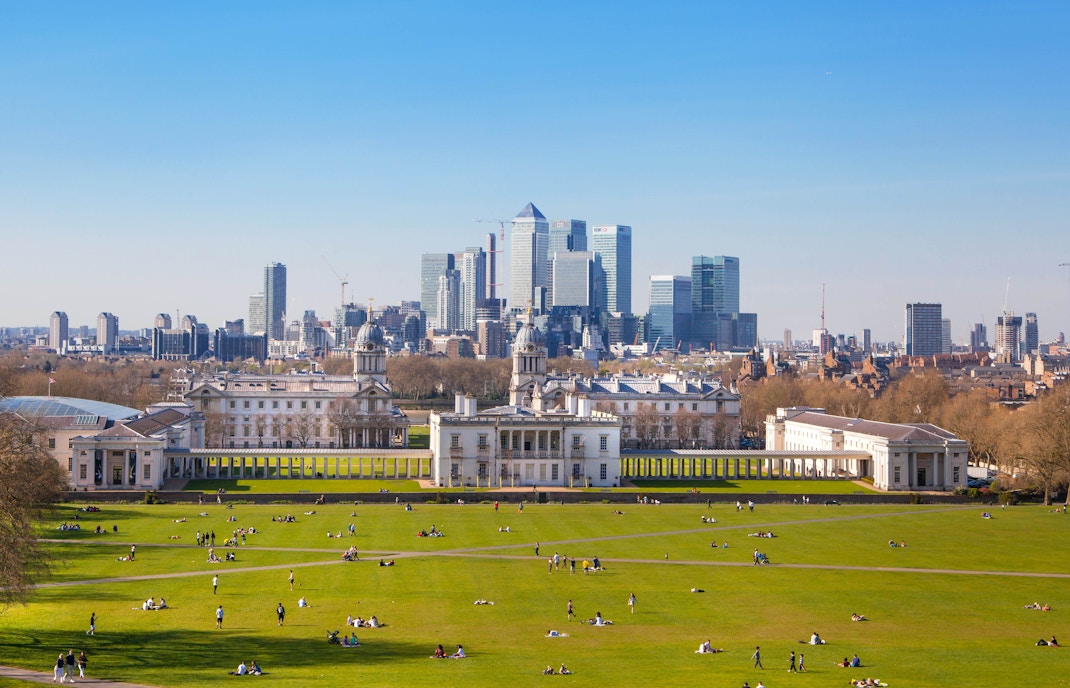
It climbs steadily from the museum's back gates up to a ridge where the Royal Observatory sits, looking north over everything below it. From the top of that hill you can see the Queen's House, the Naval College, the river, Canary Wharf, and the City of London all at once, laid out in front of you like a diagram of the last five hundred years.
The town in between
The town itself, with its market, its pubs, its independent shops and cafes, fills the streets between the river and the park.
It is all walkable. The distance from the Cutty Sark at the river to the observatory on the hill is less than a kilometre. You could cover it in fifteen minutes if you walked straight through. The point is not to walk straight through.
Top sights in Greenwich
The Cutty Sark
First sight from Greenwich Pier, built 1869 for the China tea trade.
Hull suspended over glass floor; below decks show tight crew quarters.
Designed by Christopher Wren in the 1690s on the site of Henry VIII’s birthplace.
Twin domes frame the Queen’s House; colonnades and riverside terrace open to visitors.
Frequently used as film location.
Free to enter.
Stay as long as you like.
The Painted Hall
Ceiling painted by Sir James Thornhill 1707–1726.
Allegory of British naval power; Nelson lay in state here in 1805.
Temporary art installations may be on display.
Small entry fee.
Allow 15–20 minutes.
Chapel of St Peter and St Paul
Rebuilt 1789; neoclassical interior with painted ceiling and decorative plasterwork.
Still hosts services; quiet space often overlooked.
Free to enter.
Five minutes recommended.
National Maritime Museum
Largest maritime museum in the world; British naval history from exploration to present.
Highlights include Nelson’s Trafalgar coat, Turner’s Fighting Temeraire, Harrison’s timekeepers, and Cook’s journals.
Central courtyard café available.
Free to enter.
Allow 60–90 minutes.
Queen’s House
Palladian villa by Inigo Jones, 1635; first classical building in England.
Great Hall’s marble floor and Tulip Stairs are key highlights.
Art collection includes Gainsborough, Hogarth, Canaletto.
Free to enter.
Allow 30 minutes.
Greenwich Market
Covered Victorian market, 40 food traders daily; antiques and makers on specific days.
Nearby Goddards serves traditional pie and mash; 15 Grams and Greenwich Grind for coffee.
Free to enter.
Budget £8–12 for food.
St Alfege Church
Designed by Hawksmoor, completed 1714; Thomas Tallis buried here.
Quiet interior, often missed by visitors.
Free to enter.
About 20 minutes.
Crooms Hill and Fan Museum (detour)
Historic Georgian street; independent shops and cafés.
Fan Museum dedicated to hand-held fans, afternoon tea in the Orangery garden on select days.
Free entry to street; museum ticketed.
Allow 30–45 minutes.
Greenwich Park
74 hectares of Royal parkland; cherry blossom in spring, autumn colour later.
Fallow deer visible on eastern slope; Rose Garden near Blackheath Gate.
Free to enter.
Climb to observatory ~15 minutes.
Royal Observatory and Prime Meridian
Built 1675 to solve longitude at sea; Harrison’s H4 on display.
Brass strip marks Longitude Zero; green laser visible at night.
Ticket required. Book in advance.
Hilltop View
Ridge in Greenwich Park overlooking Queen’s House framed between Naval College domes, Thames, Canary Wharf, and City of London.
Free. No ticket required.
Ranger’s House (detour)
Georgian villa housing Wernher Collection of art and jewellery.
Managed by English Heritage; largely unknown to first-time visitors.
Ticketed.
Allow 45 minutes.
Blackheath
Open common south of park; wide vistas with Georgian village on edge.
Historical site of peasants’ camp and royal meetings; cafés and walking paths.
Free to enter.
Local bites and riverside cafés
Greenwich is not a destination for a single type of eating. It has historic pubs that have been on the same site for 150 years, a covered market full of international food traders, a neighbourhood pizza restaurant with a serious local following, and independent cafes tucked into streets that look like they have barely changed since the Victorian era.
Goddards at Greenwich
On King William Walk just outside the market entrance since 1890, Goddards serves pie and mash with parsley liquor, the traditional London working-class dish that has sustained dockworkers and market traders in this part of the city for over a century.
Family run, no-frills, and entirely genuine.
The lunchtime queue is almost entirely locals, which tells you everything.
If you want the full experience, order the jellied eels too.
Traditionally London, and worth trying at least once.
Trafalgar Tavern
Two minutes east of the Cutty Sark along the riverside path, the Trafalgar Tavern has been on the Thames since 1837.
Whitebait has been on the menu since the Victorian era, when Dickens and Thackeray were regulars and politicians held famous whitebait dinners here after parliamentary sessions.
Sit by the river-facing windows, order the whitebait, and stay longer than you planned.
It is the right way to end a day in Greenwich.
The Old Brewery
Inside the Naval College grounds in an 18th-century Grade II listed building, the Old Brewery serves craft beer alongside seasonal British food with an outdoor terrace that catches the afternoon sun.
Sunday roasts here are a local ritual, and the setting, inside a working brewery within a baroque naval complex, is unlike anything else in the city.
Heaps Sausage Deli
Before you do anything else, if you are arriving in the morning, stop at Heaps Sausage Deli near the Cutty Sark for a breakfast roll.
Handmade sausages, bacon, eggs, and enough substance to carry you through a morning of climbing hills and standing on meridian lines.
It is a local institution that most tourists walk straight past, and the kind of place that sets the right tone for the day.
Greenwich Market food stalls
The covered market is where most visitors eat lunch and it earns the stop.
Around forty international food traders operate inside the Victorian hall every day, covering Nepalese momos, Sicilian cannoli, South American empanadas, Ethiopian injera, Korean fried chicken, and handmade pasta, with communal tables inside and in Fry's Yard outside.
No reservation, no menu to study, no wrong choice. Budget £8 to £12 and eat well.
15 Grams
The best independent coffee in the neighbourhood, a short walk from the market.
The cortados have a following that extends well beyond Greenwich.
Go before the market fills up or after the hill if you need a reason to slow down before heading back to the river.
Greenwich Grind
Next door to the market, Greenwich Grind does coffee by day and cocktails by night in a space that handles both without feeling divided.
Good for a mid-morning stop or an early evening drink before dinner.
The cocktail list is longer than you expect from a place this size.
Meantime Brewery
If you are heading toward the peninsula or the O2, Meantime Brewery on Blackwall Lane is worth a stop.
One of London's most celebrated independent breweries, the taproom serves their full range on site including seasonal batches that do not make it into distribution.
A short taxi or bus ride from the historic centre, but the right kind of detour for anyone who takes beer seriously.
A note on the Fan Museum afternoon tea: served in the walled Orangery garden on the first Friday and the second and fourth Sundays of each month. Book ahead. One of those experiences that is completely unlike anything else in Greenwich and tends to be fully booked weeks in advance.*
Greenwich itinerary to plan you day
Three to four hours. The historic core, done properly.
Start at Greenwich Pier. Pause before you move. The twin domes of the Old Royal Naval College frame the Queen’s House perfectly between them. That view was designed to be seen from the water. It still works.
Walk to the Cutty Sark and go straight on board. Below deck first. Stand beneath the hull and look up through the glass. Arrive early if you can. By mid-morning, the lower decks fill quickly. Give it forty-five minutes.
Cross into the Naval College grounds. Take the riverside terrace for the view, then step inside the Painted Hall. It rarely has a queue. Fifteen minutes is the minimum. Look up longer than feels natural.
Behind the college, the National Maritime Museum and the Queen’s House sit side by side. If time is tight, head for Nelson’s coat first. The bullet hole says enough on its own. Thirty to sixty minutes here is realistic.
Eat at Greenwich Market before climbing the hill. It closes at 5.30pm.
Enter Greenwich Park through the rear gate. The path rises steadily to the Royal Observatory. Stop at the ridge before you go in. The Queen’s House sits between the domes, the Thames behind it, the City beyond.
Book the observatory in advance. Leave it until afternoon if you want better light and thinner crowds.
Six to seven hours. The same ground, at a human pace.
Begin when the doors open. The Cutty Sark is quieter at 10am, and the ship feels more like a vessel than an attraction. Stay an hour. Let it settle.
Walk the Naval College without heading anywhere in particular. The courtyards, the symmetry, the way the domes frame the sky. Then give the Painted Hall the time it deserves. Forty minutes changes the experience.
In the Maritime Museum, allow yourself to drift. Nelson’s coat, Harrison’s timekeepers, Turner’s Fighting Temeraire. Use the café when you need a break. The Queen’s House next door rewards unhurried looking.
For lunch, step outside the main circuit. Goddards on King William Walk has served pie and mash since the nineteenth century. It feels rooted.
In the afternoon, explore beyond the obvious. Walk Crooms Hill along the park wall. Step into St Alfege Church for a moment of stillness. Let the neighbourhood feel lived in.
Enter the park mid-afternoon. Sit before climbing higher. Inside the Royal Observatory, spend time with Harrison’s H4. It looks modest. It changed navigation.
If you still have energy, exit onto Blackheath and walk the open common before returning through the park as the light lowers. End by the river. It is the right way to close the day.
The same place. A different rhythm.
Start with the Cutty Sark. It needs no explanation. The glass floor beneath the hull does the work. The low ceilings and narrow bunks make history tangible. Stay as long as attention holds.
Walk through the Naval College and let the scale speak for itself. Try the Painted Hall briefly if they are old enough to look up and take it in.
Eat at the market, it closes at 5.30pm. It solves decisions and moods in one move.
Enter the park and aim for the playground near Blackheath Gate before heading uphill. The climb becomes part of the adventure rather than an obligation.
Book the planetarium in advance. The show is short, focused, and holds attention. Pair it with the observatory, but keep expectations realistic about how long they will want to stay.
On the way down, pass the deer enclosure in the late afternoon. It is often the moment they remember most.
Leave by train when everyone is tired. Eight minutes to London Bridge feels like a gift at the end of a long day.
Unique finds and souvenirs
Greenwich is not a shopping destination in the Oxford Street sense, but it has something more interesting than that: a genuine mix of antique dealers, independent makers, and specialist shops concentrated in and around the market, along Greenwich Church Street, and up Crooms Hill. The best things to buy here are the things you will not find anywhere else.
Greenwich Market
The covered market divides neatly by day.
On Tuesdays and Thursdays, antiques and collectibles traders bring old maps, nautical instruments, vintage watches, framed prints, and objects from house clearances.
These are the days for finding something genuinely unusual.
At weekends and on Mondays, Wednesdays, and Fridays, independent makers take over: jewellers, ceramicists, textile designers, and printmakers producing work that is specific to them rather than to a brand.
The Junk Shop
On Greenwich Church Street, the Junk Shop is a rabbit warren of floors and rooms filled with vintage crockery, antiques, curious objects, and things that resist easy categorisation.
There is a small tea room in the back and a takeaway coffee counter near the entrance. Go without a list and allow more time than you think you need.
Crooms Hill independents
The Georgian street running alongside the park wall has a scattering of independent boutiques and specialist shops that are worth browsing slowly.
The pace here is different from the market: quieter, less browsed, and more likely to yield something genuinely specific
Royal Museums Greenwich shops
The gift shops at the Cutty Sark, the National Maritime Museum, and the Royal Observatory stock a range of maritime and astronomy-themed items that are specific to these collections: prints, instruments, navigation-themed homeware, and books that you will not find in a standard gift shop.
The observatory shop in particular stocks items tied to the history of timekeeping and navigation that make thoughtful and unusual gifts.
What to look for
Old maps and navigation charts from the antiques traders on Tuesdays and Thursdays. Handmade jewellery from the weekend craft market.
Ceramics and printed work from independent makers.
Vintage watches and nautical instruments.
Books on maritime history, astronomy, and London from the museum shops and second hand stalls.
Dark Sugars chocolates and truffles to take home.
Arriving in Greenwich
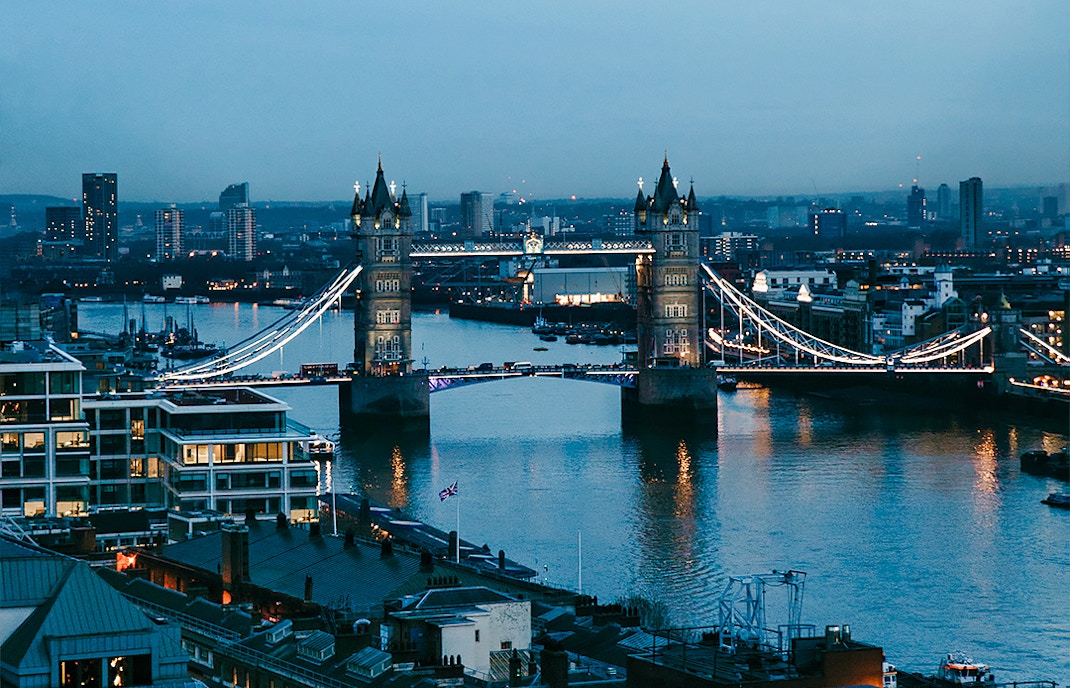
The Thames Clipper from the London Eye, Embankment, or Tower Bridge takes between 25 and 40 minutes depending on where you board, and the journey is part of the experience.
You pass under bridges, move alongside Canary Wharf, and then, as you round the bend at Greenwich, the masts of the Cutty Sark appear above the roofline and the twin domes of the Old Royal Naval College rise behind her.
You step off the boat at Greenwich Pier with the river behind you and five centuries of history in front.
Clippers run every 20 minutes, take Oyster cards and contactless, and cost about the same as a bus fare.
The Southeastern service from London Bridge to Greenwich station takes eight minutes and runs every ten minutes.
It is the fastest option from central London and deposits you five minutes' walk from the riverfront.
Recommended for journey back from Greenwich.
DLR
The DLR from Bank station runs to Greenwich in around 20 minutes.
Note that Cutty Sark DLR station is temporarily closed for escalator works until spring 2026.
Use Greenwich mainline station instead during this period
North Greenwich on the Jubilee line is the nearest underground station, but it sits on the peninsula near the O2 and is a bus ride from the historic town centre.
It is the right option if you are combining your visit with the O2 or the cable car, but not the most direct route for the main sights.
Arrive by river from the London Eye or Tower Bridge.
Leave by train from Greenwich station back to London Bridge.
You get the atmosphere in one direction and the speed in the other, and you see two completely different faces of the city in a single day.
Seasonal highlights and views
Greenwich is worth visiting in any season, and the covered market and indoor museums mean a rainy day rarely ruins a visit. But each time of year offers something genuinely different, and knowing what to expect changes how you plan.
Spring is when the park earns its reputation in a different way.
The cherry blossom on the lower slopes draws visitors from across the city in March and April, though the exact timing shifts each year with the weather.
The chestnut trees follow later with a slower, deeper green.
The light on the hill in April, long and low in the late afternoon, is some of the best the park gets all year.
Crowds are building but have not yet reached summer levels. Weekday mornings in April are close to ideal.
Summer is the busiest period and unambiguously the most social.
The riverside pubs open their terraces, the park fills with picnics, and the market operates at full energy seven days a week.
The observatory courtyard is at its most crowded between June and August, particularly on weekends and school holidays.
Arrive early, before 9am, and you will have the meridian line to yourself.
Stay late: the green laser from the observatory becomes visible after dark and the river at dusk, seen from the Trafalgar Tavern terrace, is one of the better summer evenings London offers.
Autumn is the season that most rewards a slow visit.
The old chestnut trees turn golden from October onward and the low light through them makes the hill look different from one week to the next.
The deer on the eastern slope are more visible as the undergrowth thins.
The museum galleries are quieter. The Painted Hall has breathing room.
The market antiques days have a particular atmosphere in autumn, with the air cool enough to make the covered hall feel like a proper retreat.
Come on a weekday in October and you will have the park almost to yourself.
Winter has its own reasons.
The Christmas market fills the streets around the Naval College from late November and a pop-up skating rink appears outside the Queen's House with the domes lit behind it: genuinely festive and not yet as overwhelmed as the central London equivalents.
Midweek visits in December are relaxed in a way that summer weekends are not.
The museums are at their quietest and the Painted Hall, with winter light coming through the windows, has a different quality from its summer self.
After dark, the meridian laser is visible earlier and for longer.
The single best time to visit, if you are choosing: a weekday morning in October. The park is at its most beautiful, the sights are at their quietest, and the whole place feels like it belongs to you.
Plan your Greenwich visit
Royal Observatory and Cutty Sark require tickets; the Royal Museums Greenwich Day Pass covers both.
National Maritime Museum, Queen’s House, Painted Hall, Naval College grounds, Greenwich Park, and St Alfege Church are free.
Book timed entry for observatory, Cutty Sark, and Fan Museum afternoon tea in advance.
Popular restaurants like Wandercrust and Sticks’n’Sushi may need reservations on Fridays and Saturdays.
The historic core (Cutty Sark to observatory) is under 1 km and walkable.
Eltham Palace requires a bus or train. The O2 and cable car are best reached via Thames Clipper or DLR.
Museums, Cutty Sark, and lower park areas are fully accessible.
Observatory path is a 15-minute uphill walk with benches; Naval College riverside terrace offers free views.
Peter Harrison Planetarium for ages six and up; book shows in advance.
Greenwich Market is convenient for family lunches.
Allowed in Greenwich Park on leads near deer enclosure.
Most riverside pubs are dog-friendly.
Dogs not permitted inside museums or Cutty Sark.
Explore other London neighbourhoods
Soho · 🚶 Central London
Music clubs, theatres, bars, and independent shops. Streets buzz day and night, with hidden courtyards, colourful façades, and a mix of global eateries.
Kensington · 🚶 West London
Elegant streets lined with museums, garden squares, and boutique shops. Perfect for art, history, and a relaxed stroll through leafy avenues.
Waterloo · 🚶 Central London
Southbank culture hub with theatres, galleries, and riverside walks. Street art, historic pubs, and views of the London Eye make it lively day and night.
Westminster · 🚶 Central London
Iconic London landmarks at every turn. Big Ben, Westminster Abbey, and Parliament Square mix history, politics, and riverside vistas in a compact walkable area.
Frequently asked questions about Greenwich
Most of Greenwich is free. Paid attractions include the Royal Observatory (£18+) and the Cutty Sark (£20+).
A half day covers the historic core. A full day adds Blackheath, local streets, and riverside pubs. Two days lets you include Eltham Palace.
Historic Greenwich is the riverside neighbourhood with the park, market, museums, and world heritage sites. North Greenwich, two miles away, is home to the O2 Arena and cable car.
By river: Thames Clipper from central London for a scenic arrival.
By train: London Bridge to Greenwich station in 8 minutes.
By DLR: From Bank, around 20 minutes.
By tube: North Greenwich station is near the O2, not the historic centre.
Yes. The historic core, from the Cutty Sark to the Royal Observatory, is under a kilometre. Blackheath and Eltham Palace require extra travel.
Yes. Highlights for children include the Cutty Sark, Greenwich Park playground, and Peter Harrison Planetarium. Greenwich Market handles casual family lunches.
Dogs are welcome in Greenwich Park on a lead. Riverside pubs and Greenwich Market are dog-friendly. Museums and the Cutty Sark do not allow dogs.
Yes. Grounds are free. The Painted Hall has a small entry fee and timed access. St Peter and St Paul’s Chapel is free. Visitor centre has maps and luggage facilities.
Morning for the Cutty Sark and Painted Hall before crowds. Afternoon for Greenwich Park and the Royal Observatory when light is warmest.
Meridian line at the Royal Observatory, hill ridge view, Nelson’s uniform at the National Maritime Museum, Fan Museum on Crooms Hill.
Greenwich Market, Goddards pie and mash, 15 Grams coffee, Greenwich Grind, Dark Sugars chocolate and gelato.
Things To Do in GreenwichCrafted by Headout, a global experiences brand offering curated tours, tickets & experiences. Discover with ease, book with peace.