Budget 2 to 3 hours for a proper visit across the ship’s nine decks. Allow closer to 3 hours if you want to read the displays, spend time in the machinery spaces or visit with children. A shorter 90-minute visit can cover the main decks, gun turret, command areas and a few crew spaces, but you will need to move quickly.
HMS Belfast guide I A wartime cruiser on the Thames
Quick Information
Is the HMS Belfast worth visiting?
HMS Belfast feels less like a museum and more like a ship that has simply stopped sailing. Steel ladders creak underfoot, passageways narrow between pipes and machinery, and the Thames moves outside the portholes. You can still see the cramped hammocks where sailors slept, the sick bay where wounded men were treated, and the enormous gun turrets that once fired at enemy positions.
She was built as a light cruiser for the Royal Navy, designed to protect British shipping and fight at sea. That purpose is still obvious when you move from the crew quarters into the weapons and command spaces.
The emotional payoff is scale and proximity. D-Day, Arctic convoys and the Korean War stop feeling like distant textbook events when you are standing inside the rooms where sailors lived through them.
Skip it if: you have under 90 minutes, dislike ladders and confined spaces, or would rather spend your London day outdoors than inside a historic warship.
What to see on HMS Belfast?

1/8
The Main Deck and crew spaces
See the messdecks, galley, bakery and living areas where a crew of around 950 ate, slept and worked. The hammocks packed tightly together make the realities of life at sea immediately clear.
A-Turret and the Gun Turret Experience
Get close to one of HMS Belfast’s 6-inch gun turrets and see the machinery that allowed the ship to deliver heavy naval fire. The Gun Turret Experience recreates the intensity of combat conditions.
The Operations Room
See where information from radar, sonar and other sources was brought together to track ships and coordinate the cruiser’s movements. Interactive displays help explain how naval decisions were made.
The Admiral’s Bridge and Compass Platform
Move into the command spaces used to navigate and direct the ship. The Compass Platform also connects directly with HMS Belfast’s D-Day story, including its wartime log and the coordination of naval operations.
The Arctic Messdecks
See the cramped sleeping quarters used during the Arctic Convoys, when HMS Belfast sailed in freezing conditions to protect Allied supply routes to the Soviet Union. The tight hammocks make the harsh conditions easier to picture.
The Engine and Boiler Rooms
Head below the waterline to see the machinery that powered this 11,553-ton cruiser. These spaces show the physical scale of the ship better than the upper decks, with huge equipment packed into narrow working areas.
The Sick Bay
See the ship’s medical facilities, including its sick bay, operating theatre and dental surgery. During wartime, HMS Belfast effectively carried a small medical centre alongside its weapons, navigation and living spaces.
The Boat Deck and Flag Deck
Look across the Thames from the upper decks and get a better sense of HMS Belfast’s size. The Flag Deck also provides a high vantage point over London, contrasting the ship’s wartime role with its present-day riverside setting.
How to explore HMS Belfast
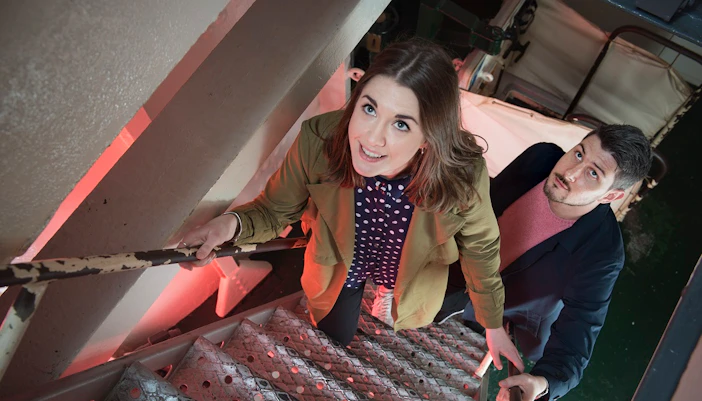
How much time to spend?
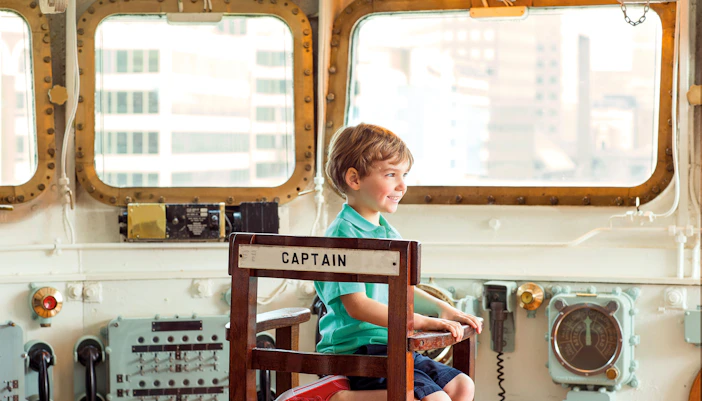
Best visit order
Start with the lower and main decks, where the messdecks, galley, sick bay and machinery establish what daily life was like. Work upwards through A-Turret and the command areas, finishing on the upper decks for the Flag Deck, Compass Platform and Thames views. Follow the ship’s marked route rather than repeatedly doubling back; the ladders and narrow passageways make retracing your steps slower than on a conventional museum visit.

Must-see highlights
Must-see: A-Turret, the Operations Room, Arctic Messdecks, Engine and Boiler Rooms, Admiral’s Bridge and Flag Deck.
Optional: The smaller crew rooms and specialist working spaces add considerable detail but can take another 30–45 minutes if you stop to read everything.
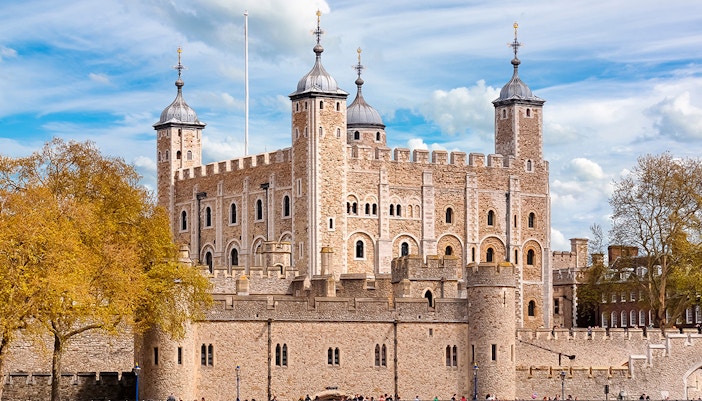
Worth adding nearby
The Tower of London is a natural pairing across the river and needs around 2–3 hours on its own. Borough Market works better if you want food rather than another major attraction and can add 45–60 minutes. For a lighter South Bank combination, walk along the Thames towards Tate Modern after leaving HMS Belfast; allow around 20 minutes to reach it on foot.

Guided or self-paced?
Self-paced is the better choice if you want to stop whenever a cramped cabin, piece of machinery or view catches your attention. The ship already has a clear visitor route and audio-guide points. A guided tour becomes worthwhile if you want the D-Day timeline or wartime stories explained by an expert rather than pieced together from displays. IWM currently offers guided D-Day and Second World War tours that include HMS Belfast admission.
Brief history of HMS Belfast
- 1936: Construction of the Town-class light cruiser begins at Harland and Wolff in Belfast as part of the Royal Navy’s expansion programme.
- 17 March 1938: HMS Belfast is launched by Anne Chamberlain, wife of Prime Minister Neville Chamberlain.
- August 1939: She is commissioned into the Royal Navy shortly before the Second World War begins.
- November 1939: A German magnetic mine damages the cruiser, keeping her out of service for around three years while repairs and reconstruction take place.
- 1943: HMS Belfast returns to active service, escorting Arctic Convoys and taking part in the Battle of North Cape, where Allied forces helped sink the German battleship Scharnhorst.
- 6 June 1944: She leads the naval bombardment supporting the D-Day landings in Normandy and continues supporting Allied troops for five weeks.
- 1950–1952: HMS Belfast serves in the Korean War, spending 404 days on active service.
- 1963: She is retired from active Royal Navy service and faces possible scrapping.
- 1971: A preservation campaign saves HMS Belfast. She arrives in London and opens to the public on 21 October.
- 1978: Imperial War Museums takes ownership of HMS Belfast, which remains part of IWM's collection today.
Architecture and design of HMS Belfast
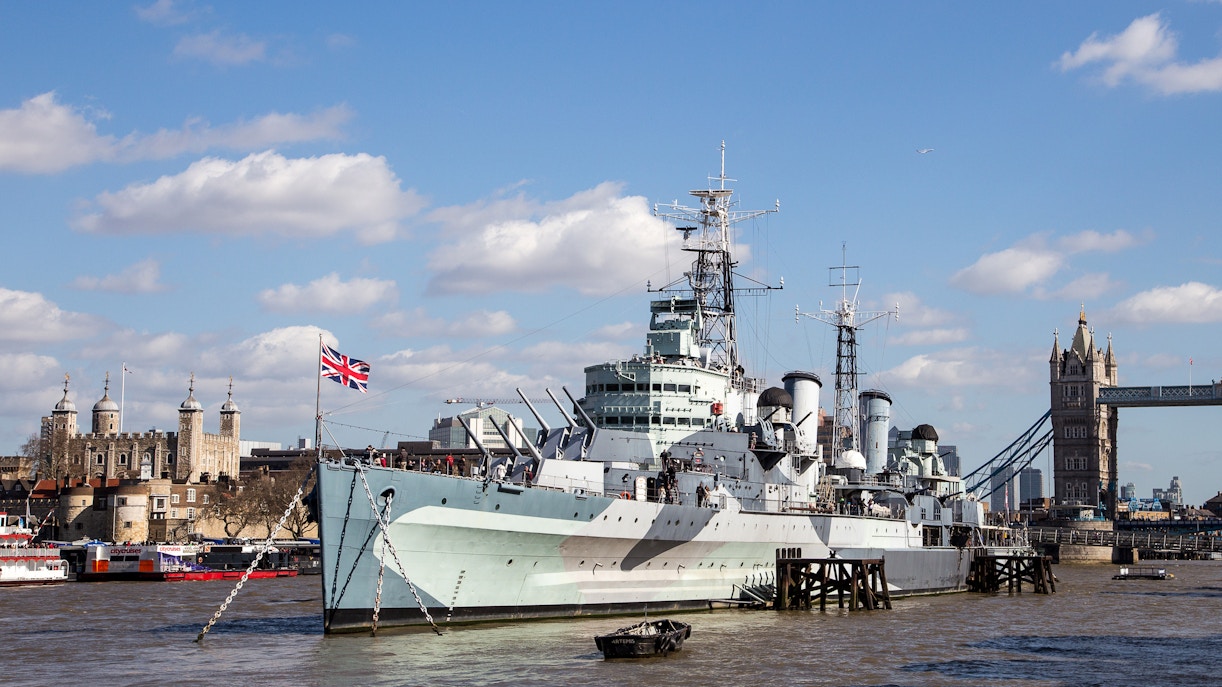
HMS Belfast was built for function rather than comfort, and the ship’s design makes that immediately apparent. As a Town-class light cruiser, she combines large open gun positions with tightly packed machinery, command rooms and crew quarters. More than 11,000 tons of steel are arranged vertically as well as horizontally, creating a ship where ladders, hatches and narrow passageways connect working spaces spread across nine decks.
The contrast is what makes the architecture interesting. The upper decks feel open, exposed and commanding, while the lower levels become darker, hotter and increasingly mechanical. Pipes run overhead, machinery fills narrow rooms and the crew quarters reveal just how little personal space was available. The ship was designed to operate at sea under combat conditions, so almost every part has a practical purpose.
Who built HMS Belfast?
HMS Belfast was built by Harland and Wolff, the Belfast shipbuilding company responsible for constructing many major vessels, at its Queen's Island yard. She was one of the Town-class light cruisers commissioned by the Royal Navy during its pre-war expansion. Her design prioritised speed, firepower and endurance rather than passenger comfort.
Life aboard HMS Belfast
HMS Belfast was effectively a small floating town for the roughly 950 people who lived and worked aboard her. The ship had its own bakery, galley, chapel, radio station, sick bay and messdecks, alongside the machinery and weapons needed for combat.
Daily life depended heavily on cramped shared spaces and strict routines. Sailors slept in tightly packed hammocks, ate meals prepared for nearly 1,000 people and worked around machinery, weapons and navigation equipment. During the Korean War, the crew even consumed more than 56,000 pints of rum over the course of the ship’s service there.
Frequently asked questions about HMS Belfast
Yes. Visitors can enter the A-Turret area and access the Gun Turret Experience, which recreates the workings and atmosphere around one of HMS Belfast’s main 6-inch gun installations. Some areas involve narrow passages and ladders.
Yes. HMS Belfast led the naval bombardment supporting the Allied landings on 6 June 1944. She continued firing in support of Allied troops for five weeks and fired her last wartime shots in European waters on 8 July.
Yes. HMS Belfast served in Korea from 1950 to 1952, spending 404 days on active service. She operated close to the enemy-held shoreline and used her guns to support United Nations forces.
Most visitors can follow the route across all nine decks, but access varies because the ship is a working warship preserved as a museum. Vertical ladders, narrow passageways and occasional operational closures can restrict access to some areas.
Access is limited because several parts of the ship can only be reached by ladders. IWM notes that step-free access is not always available and advises checking the access information for your chosen date. The accessible route and available spaces vary.
Yes. Children can visit HMS Belfast with an accompanying adult, and the ship has interactive displays and family-focused activities. Younger children may find the ladders, confined corridors and uneven surfaces more challenging than a conventional museum.
A pushchair is not practical for much of the ship because the visitor route includes ladders, narrow passageways and areas that are not step-free. Families with very young children should be prepared to carry them for parts of the visit.
Yes. HMS Belfast has a café, although opening arrangements can vary. The café and shop currently accept card payments only, so do not rely on cash for purchases aboard the ship.


