London Tickets

Quick Information

RECOMMENDED DURATION

2 hours

VISITORS PER YEAR

100000

EXPECTED WAIT TIME - STANDARD

2+ hours (Peak), 30-60 mins (Off Peak)

Plan your visit

Did you know?

Unlike most roof climbs, Up at The O2 ascends the O2's signature white fabric membrane, making it feel like you're walking on air.

Originally named the Millennium Dome, The O2 was constructed to mark the turn of the millennium.

Holding the title of the largest domed structure globally, The O2 boasts a monumental diameter of 365 meters, making it an architectural marvel and an iconic London landmark.

Is Up at The O2 worth visiting?

Yes—if you want a London view that feels earned rather than simply observed. From Base Camp, you pull on a climb suit, clip into a harness and follow a guided walkway up the curved white roof of The O2. Around you, the city opens up: the Thames winding past Greenwich, Canary Wharf rising to the east and the London skyline stretching beyond.

The O2 climb experience was created to give visitors a new way to engage with one of London’s most recognisable landmarks—not simply to look at it, but to walk across it. That sense of purpose is what makes the 90-minute climb feel different from a standard observation deck. Every step is guided, tethered and deliberate, building towards a summit platform where the river, docks and skyline feel suddenly close.

You leave with more than photographs. You leave with the quiet satisfaction of having climbed over one of the city’s most famous structures.

Skip it if you have a severe fear of heights, cannot manage a 90-minute guided activity, or prefer a relaxed, unguided skyline view without physical effort.

Up at The O2 vs The O2 arena: key differences

ParameterUp at The O2The O2 arena

What it is

A 90-minute outdoor guided climb over The O2’s roof, reaching 52 metres.

An indoor venue hosting concerts, comedy, sport and family shows.

What you book

A timed climb slot on a chosen date.

A ticket for one specific event.

Ticket types

Daytime climb, Sunset or Twilight climb, Celebration climb, and a combo with the IFS Cloud Cable Car.

Floor, seated or standing tickets, depending on the event. Premium hospitality options are also available.

What gives you entry

Your climb ticket, shown to reception at Basecamp. Basecamp is just outside the main entrance of The O2.

Your event e-ticket, accessed through The O2 venue app.

Before you arrive

Complete an online declaration and waiver in advance. Arrive 15 minutes before your slot. Late arrivals are not admitted.

If your ticket doesn’t appear in the app, bring photo ID matching the booking and your confirmation email to the box office 90 minutes before doors.

Timings

A 90-minute climb.

Door and show times are listed on each event page.

Age rules

Minimum age 8 and minimum height 1.2m. Climbers aged 8 to 17 need adults at a ratio of 1 adult to 5 minors.

All children need a ticket. Children aged 14 or under must be with an adult aged 18+. Standing areas aren’t suitable for under-16s.

Physical and health limits

Maximum weight 130kg and maximum waist 125cm. Not suitable for pregnant guests. No climbing within 12 months of an epileptic seizure. Climbers must not be under the influence of alcohol or drugs.

All children need a ticket. Children aged 14 or under must be with an adult aged 18+. Standing areas aren’t suitable for under-16s.

Bags and items

Only a smartphone or small compact camera can go up. Everything else is stored.

One small bag per person, A4 size or smaller. No backpacks or large bags. No outside food or drink.

Accessibility

A free carer ticket is available for climbers who need one, when booked directly with the venue and supported by an Access or Nimbus card. A dedicated wheelchair climb is also offered.

Accessible tickets require a Nimbus Access Card. Step-free access, lifts, accessible toilets, priority entry, assistance dogs, and medical equipment are supported; medical food needs 7-day approval.

What to expect at Up at The O2?

Guide conversing with tourist
1/6

Base Camp check-in

The climb begins at Base Camp, where you check in, meet your guide, and collect a climbing suit, harness, and boots. Staff explain the route, safety rules, and what to expect before you step outside. Most visitors allow 15–20 minutes here; arrive early, as your briefing time is fixed and late arrivals may miss their slot.

The briefing

Before the ascent, guides walk the group through the harness, clip-in process, and walkway rules. It is short but important, especially for first-time climbers or anyone nervous about heights. Listen for the guide’s tips on pacing and photo stops. The climb is guided throughout, so there is no need to navigate the roof route yourself.

The ascent walkway

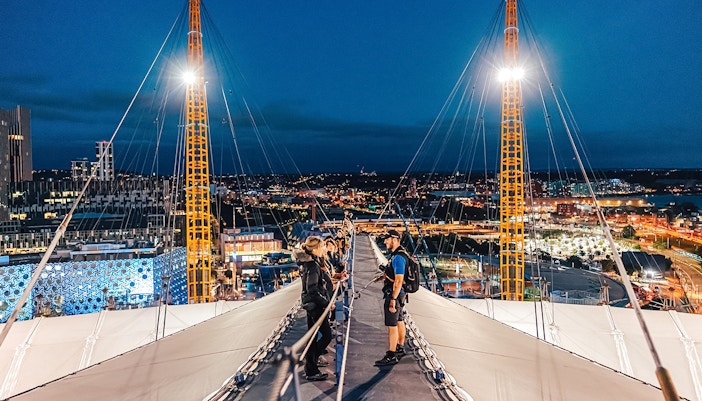
A cable-guided walkway rises across the exterior of The O2’s white dome. The gradient is steady rather than steep, and the view widens with every section as Greenwich, the Thames, and Canary Wharf come into view. This is the part visitors remember most. Pause when your guide allows it—the changing perspective over the river is one of the best photo opportunities of the climb.

The summit platform

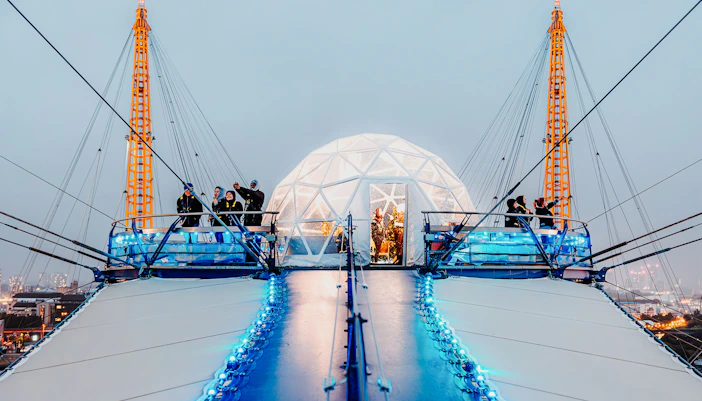
At around 52 metres above ground, the central summit platform delivers a 360-degree view across London. Look east towards Canary Wharf, south across Greenwich Peninsula, and west towards the City and central London skyline. Most groups pause here for 10–15 minutes. On clear days, the view stretches far beyond the immediate riverside, making it the climb’s main payoff.

The descent walkway

The return route crosses back down the dome towards Base Camp. The descent feels quicker, but it gives you a second chance to take in the Thames, the O2 arena below, and the Peninsula’s modern skyline. Keep both hands on the guide rope and follow your guide’s pacing. The walkway remains fully supervised from summit to exit.

Base Camp exit

Back at Base Camp, you return your gear and can browse photos, snacks, and Up at The O2 merchandise. It is also the easiest place to plan your next stop around Peninsula Square or The Tide. Allow 15–20 minutes after the climb. If you are continuing to Greenwich or central London, North Greenwich Pier and the IFS Cloud Cable Car are both a short walk away.

How to explore Up at The O2

How much time to spend?

Budget around 90 minutes for the climb itself, including check-in, kit-up, briefing, ascent, summit stop, and descent. Allow closer to two hours overall if you want time for photos, the Base Camp shop or a drink afterwards.

Add extra time if you are visiting with children, during peak periods, or combining the climb with dinner at The O2, a Thames river cruise or the IFS Cloud Cable Car.

Best visit order

Arrive at Base Camp 15–20 minutes before your booked slot. Check in, collect your climb suit, harness and boots, then attend the safety briefing.

Once clipped in, follow your guide up the cable-guided walkway to the summit platform. Pause for the 360-degree views, then descend at a steady pace before returning your kit at Base Camp. Booking an earlier slot usually means calmer walkways and better morning light for photographs.

Must-see highlights

  • Must-see: the summit platform, with panoramic views over the Thames, Canary Wharf, Greenwich Peninsula and central London.
  • Optional: pause during the ascent for photos of The O2’s canopy and the river below; this adds little time but gives you a different perspective from the summit.

Worth adding nearby

Pair the climb with a ride on the IFS Cloud Cable Car, a 5-minute walk away, for a contrasting aerial view over the Thames. Alternatively, take an Uber Boat by Thames Clippers trip from North Greenwich Pier, or explore The Tide, NOW Gallery and Design District on foot.

For a fuller day, add Greenwich Park, Cutty Sark and the Royal Observatory; allow at least three additional hours.

Guided or self-paced?

This is a guided experience only. Every climber wears a harness, receives a safety briefing, and is accompanied by trained guides throughout the ascent and descent. That structure is worth it if you want the security of a fully supervised rooftop route, especially if you are nervous about heights or visiting with a group.

Brief history of Up at The O2

  • 1997–1999: The building beneath Up at The O2 was constructed as the Millennium Dome, created to host the UK’s Millennium Experience and mark the start of the third millennium.
  • 2000: The Millennium Dome opened to the public on 1 January 2000. The Millennium Experience ran throughout the year before closing on 31 December, after which the site entered a period of uncertainty.
  • 2005: The Dome was officially renamed The O2 under a naming-rights agreement with the telecommunications company O2, beginning its transformation into a major entertainment destination.
  • 2007: The O2 reopened on 24 June 2007, with Bon Jovi performing the venue’s first public concert. The redevelopment added an indoor arena, cinema, restaurants and bars around the original dome structure.
  • 2012: Up at The O2 opened in June 2012, ahead of the London 2012 Olympics. It introduced a guided 90-minute walk across the roof, with a summit platform offering 360-degree views over London.
  • Today: More than one million visitors have completed the climb, making it one of The O2’s most distinctive experiences.

Architecture and design of Up at The O2

Up at The O2 sits on the roof of the former Millennium Dome, a late-20th-century tensile structure designed by Richard Rogers Partnership with engineers Buro Happold. Its vast white canopy is made from PTFE-coated glass-fibre fabric, stretched over a radial network of steel cables and supported by twelve 100-metre masts.

The dome measures 365 metres across and rises to a maximum height of 50 metres. Its lightness is the point: rather than a solid shell, the roof is a tensioned fabric surface that encloses a huge interior while remaining visually open to the sky.

The climb adds a 380-metre fabric walkway, suspended about two metres above the roof and reaching 52 metres above ground. As you ascend, the canopy's curve becomes something you feel underfoot, while the Thames, Greenwich Peninsula, and Canary Wharf open up around you.

Who built it?

The original Millennium Dome was designed by Richard Rogers Partnership, now Rogers Stirk Harbour + Partners, with structural engineering by Buro Happold. It was constructed by the McAlpine/Laing joint venture for the UK’s Millennium Experience.

Rogers was known for high-tech architecture that celebrated exposed structure, lightness and engineering clarity. The dome reflected that approach: its masts, cables and fabric canopy were left visually legible rather than concealed, turning the building’s structure into part of its design.

Climb formats and accessibility at Up at The O2

Up at The O2 runs as a fixed-sequence roof climb with a dedicated Base Camp, gear station, and summit platform at roughly 52 meters. Standard daytime, sunset, and twilight departures create different moods across the same route, with sunset usually delivering the strongest visual payoff on clear days. The experience also includes a wheelchair-accessible climb through a separate pathway and booking channel, making this one of the more thoughtfully adapted aerial experiences in London. Most visitors spend about 90 minutes climbing and closer to 2 hours on-site overall.

Frequently asked questions about Up at The O2

It’s a guided roof climb over The O2 dome, not a viewing platform. You check in at Base Camp, get suited up, briefed, clipped in, and guided along a fixed route to a summit viewpoint before descending.