Founded in 1826 by Sir Thomas Stamford Raffles, London Zoo opened in Regent's Park in 1828 as the world's first scientific zoo. It absorbed the Tower of London's royal menagerie in 1831, opened to the public in 1847, and pioneered the world's first reptile house (1849) and public aquarium (1853) — redefining how the world engaged with wildlife.
History of London Zoo | Discover the story behind the world's first scientific zoo
Before it became one of London's most beloved attractions, London Zoo was an ambitious scientific experiment. Founded in 1828 as the world's first scientific zoo, it transformed the way people studied, cared for, and connected with wildlife. From housing exotic species for groundbreaking research to pioneering modern conservation, its history mirrors the changing relationship between humans and the animal kingdom.
London Zoo timeline
1826: ZSL founded
The Zoological Society of London is founded by Sir Thomas Stamford Raffles, with the aim of pursuing the scientific study of animals.1828: Zoo opens
London Zoo opens to Fellows of the Society, and to the public with a written 'order' from a Fellow and payment of 1 shilling. The world's first scientific zoo.1831: Royal menagerie transferred
The Royal animal collection from the Tower of London is presented to ZSL. London Zoo absorbs centuries of royal animal history.1847: Doors open to all
London Zoo opens to the public without requiring a Fellow's order, making it accessible to ordinary Londoners for the first time.1853: World's first public aquarium
The world's first ever public aquarium opens at London Zoo. Originally called the 'Fish House', creator Philip Henry Gosse soon coins the term 'aquarium'.1914: Winnie the Bear arrives
Winnie the Bear is deposited at London Zoo, rescued by a regiment of the Canadian Army. Her visitors included A.A. Milne and his young son Christopher Robin — she became the inspiration for the Winnie-the-Pooh books, first published in 1926.1931: Whipsnade opens
The Zoological Society of London opens a country branch, Whipsnade Wild Animal Park, in Dunstable, Bedfordshire — a 600-acre zoo and the world's first open zoological park.1939–45: WWII disruption
London Zoo closes by government order on 3rd September 1939. Valuable animals are transferred to Whipsnade for safety. All venomous animals are destroyed to prevent dangerous escapes in the event of bombing.1991–92: Near closure
After more than a decade of financial losses, London Zoo comes close to permanent closure. A surge of public support and a £1 million donation from the Emir of Kuwait saves it.2026: 200th anniversary
ZSL celebrates 200 years of science, conservation and culture — two centuries of pioneering science, global conservation, and inspiring connections between people and wildlife.
London Zoo's history explained
The age of discovery (1826–1876)
The Victorian golden era (1847–1900)
With its gates open to all, London Zoo became one of Victorian London's great attractions. The word "zoo" itself was popularised here after an 1869 song about Regent's Park made it common currency. Jumbo the elephant arrived in 1865, popularising the word "jumbo" as a byword for anything enormous, while the zoo opened the world's first insect house in 1881.
Discovery and conservation awaken (1900–1930)
A period of groundbreaking firsts: Europe's first Komodo dragons arrived in 1913, and a Canadian Army bear called Winnie arrived in 1914, inspiring A.A. Milne's Winnie-the-Pooh. Women reshaped the institution, too — Evelyn Cheesman became the first female curator in 1916.
World War II and survival (1939–1945)
On 3 September 1939, London Zoo closed by government order. Valuable animals were evacuated to Whipsnade; all venomous animals were destroyed as a precaution against bomb damage. The zoo reopened to maintain public morale, and its East Tunnel served as an air raid shelter. It was the only time in its history that the zoo closed due to war.
A new conservation era (1958–1990)
Giant panda Chi Chi arrived in 1958, becoming a national celebrity and inspiring the original WWF logo in 1961. The zoo shifted from collection to conservation — pioneering international breeding programmes, helping found the IUCN Red List, and establishing the Institute of Zoology.
Crisis and renewal (1991–present)
Facing permanent closure in 1991 after years of financial losses, a wave of public support and a £1 million donation from the Emir of Kuwait saved the zoo. It reinvented itself as a conservation-first institution — expanding breeding programmes, global fieldwork, and community access. In 2026, ZSL marks its 200th anniversary, still one of the world's most important wildlife organisations.
Construction and architecture of the London Zoo
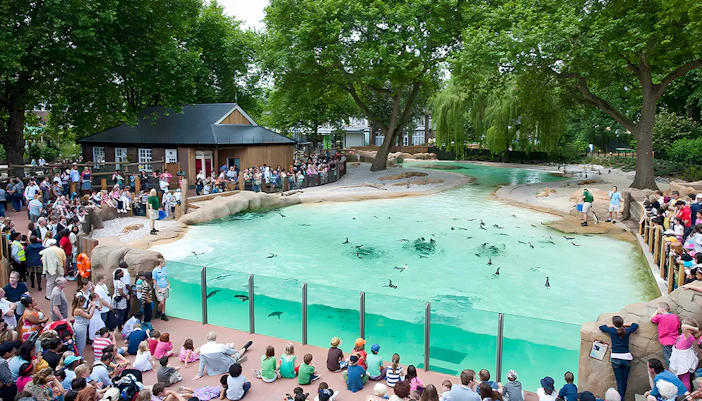
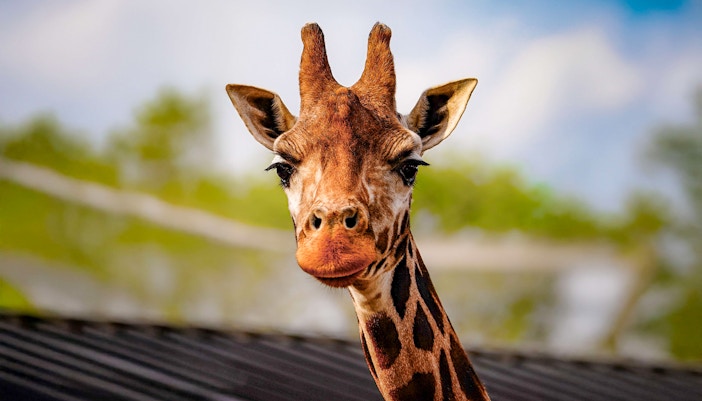
London Zoo's 36-acre site in Regent's Park has been shaped by nearly two centuries of building, with leading architects appointed in every era. Decimus Burton designed the original grounds from 1826, with surviving structures including the Clock Tower (1828) and the world's oldest zoo building still in its original use, the Giraffe House (1836–37). In the 1930s, Russian-born modernist Berthold Lubetkin designed the iconic Penguin Pool (1934) — two interlocking spiral concrete ramps that became a landmark of British architecture — and the Gorilla House (1933), one of the first modernist buildings in Britain. The Snowdon Aviary (1965), designed by Cedric Price and Lord Snowdon, was Britain's first walk-through aviary. Today, the zoo holds 13 Historic England-listed buildings, more than almost any zoo in the world.
London Zoo today — why it matters
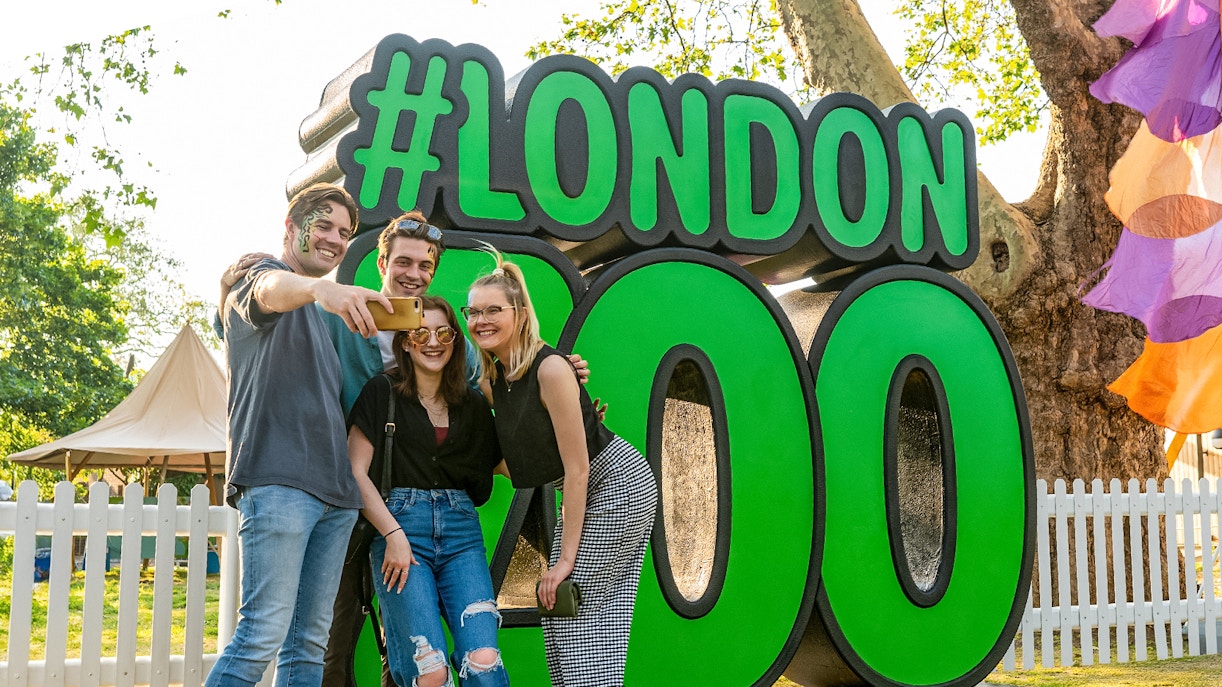
At present, London Zoo is the world's oldest scientific zoo, still operating from its original home in Regent's Park nearly 200 years on. Managed by ZSL (Zoological Society of London), every ticket sold goes directly towards protecting wildlife worldwide.
Worth visiting for more than just the animals, London Zoo is a rare combination: a living wildlife sanctuary, a working conservation research hub, and a site of genuine architectural history.
Beyond the visit, the zoo's impact runs deep. Over a dozen species here are now entirely extinct in the wild, making their breeding programmes a genuine last line of defence. ZSL's teams work across more than 70 countries, and its scientific legacy – co-founding the IUCN Red List, publishing the Living Planet Report – places it among the world's most consequential conservation institutions. The zoo's 13 Historic England-listed buildings add a layer of heritage found almost nowhere else of its kind.
Discover 200 years of London Zoo history
Popular entry times can sell out, especially during weekends and school holidays. Book your London Zoo tickets up to 2 weeks ahead to lock in your preferred time and enjoy a day discovering nearly 200 years of wildlife, conservation, and unforgettable animal encounters.
Frequently asked questions about London Zoo's history
Unlike earlier menageries, which existed mainly to display exotic animals, London Zoo was founded in 1828 to support scientific research. Zoologists could observe living animals, study their behaviour, and exchange knowledge, making it the first zoo created with science—not entertainment—as its primary purpose.
London Zoo was established by the Zoological Society of London (ZSL), founded by Sir Stamford Raffles and Sir Humphry Davy in 1826. Inspired by scientific institutions in Europe, they envisioned a permanent collection of living animals that would advance zoological research and public understanding of wildlife.
Opened in 1853, the Fish House at London Zoo became the world's first public aquarium. Designed by Philip Henry Gosse, it introduced visitors to marine life in glass tanks and popularised the term "aquarium". Its success inspired similar aquariums across Europe and North America.
Charles Darwin was among London Zoo's most notable visitors. He closely observed an orangutan named Jenny, comparing her expressions and behaviour with those of humans. These observations informed his thinking on evolution and the shared ancestry of humans and other primates.
When World War II broke out in 1939, London Zoo temporarily closed and evacuated many animals to Whipsnade Zoo. Venomous species were humanely destroyed to prevent escapes during bombing raids, while parts of the zoo served as air-raid shelters for staff and local residents during the Blitz.
Several architectural landmarks remain, including the Grade I-listed Penguin Pool (1934), the Victorian Clock Tower, the East Tunnel, and Decimus Burton's Three Island Pond. Together, they trace nearly 200 years of changing zoo design, from ornamental landscapes to modernist architecture.
London Zoo has been home to many celebrated residents, including Jenny the orangutan, Jumbo the African elephant before his move to the United States, and Winnie the bear, whose name inspired A. A. Milne's beloved character Winnie-the-Pooh after his son met her at the zoo.
London Zoo began as a private scientific collection before opening to the public in 1847. Today, while it remains a popular visitor attraction, its core mission focuses on wildlife conservation, scientific research, breeding endangered species, and educating millions of visitors about protecting biodiversity.