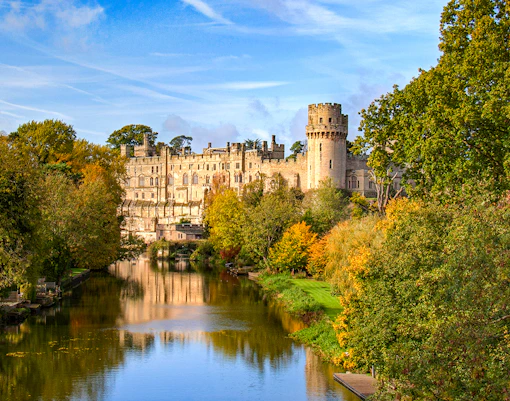
William the Conqueror founded Warwick Castle in 1068, building a wooden motte-and-bailey fortress to secure Norman control over the Midlands. Henry de Beaumont became the first Earl of Warwick in 1088, beginning a dynasty whose descendants would rule the castle for generations.
History of Warwick Castle | A Norman fortress that outlasted an empire
Few castles can claim nearly a thousand years of continuous history, but Warwick Castle can. Built in 1068 on the orders of William the Conqueror to help subdue a newly conquered England, this Norman stronghold on the River Avon evolved over the centuries from a wooden fort into one of the country's most formidable medieval fortresses, and later into a grand aristocratic residence. Today, its towers and battlements offer one of Britain's most complete windows into nearly a millennium of conquest, power, and transformation.
Warwick Castle timeline
1068: Founded by William the Conqueror
Built as a wooden motte-and-bailey fortress to help control the Midlands after the Norman Conquest.1154–1189: Rebuilt in stone under Henry II
The original timber structure is replaced with a stone shell keep, forming the foundation of today's castle.1264: Stormed during the Second Barons' War
Simon de Montfort's forces capture the castle in a surprise attack, holding the Earl of Warwick for ransom.1330s–1360s: Beauchamp earls build Caesar's and Guy's Towers
Major fortification work creates one of England's most recognisable 14th-century military facades.1469: Richard Neville, "the Kingmaker", imprisons Edward IV
During the Wars of the Roses, England's most powerful earl holds the king captive within the castle walls.1604: Granted to Sir Fulke Greville by James I
The long-decaying mediaeval fortress is transformed into a grand country house.1642: Withstands a Royalist siege in the English Civil War
Parliamentarian defenders hold out until reinforcements force the attackers to retreat.1871: Devastating fire guts the Great Hall
A deliberately started blaze destroys the private apartments; restoration takes place over the next four years.1978: Sold, after 374 years, by the Greville family
The Tussauds Group purchases the castle and opens it to the public for the first time.2007: Acquired by Blackstone, operated by Merlin Entertainments
Warwick Castle enters its current era as one of Britain's most visited historic attractions.
Warwick Castle's history explained
Construction and architecture of Warwick Castle
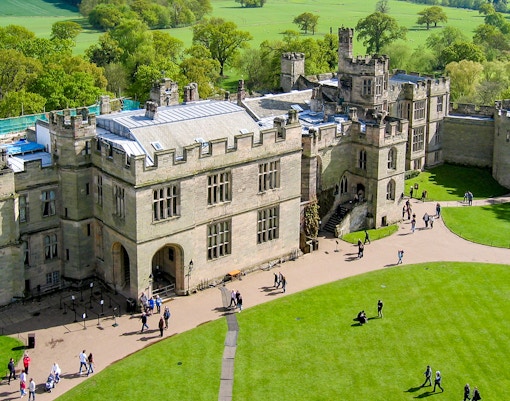
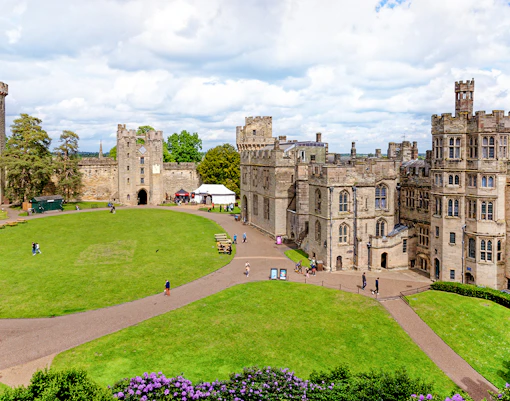
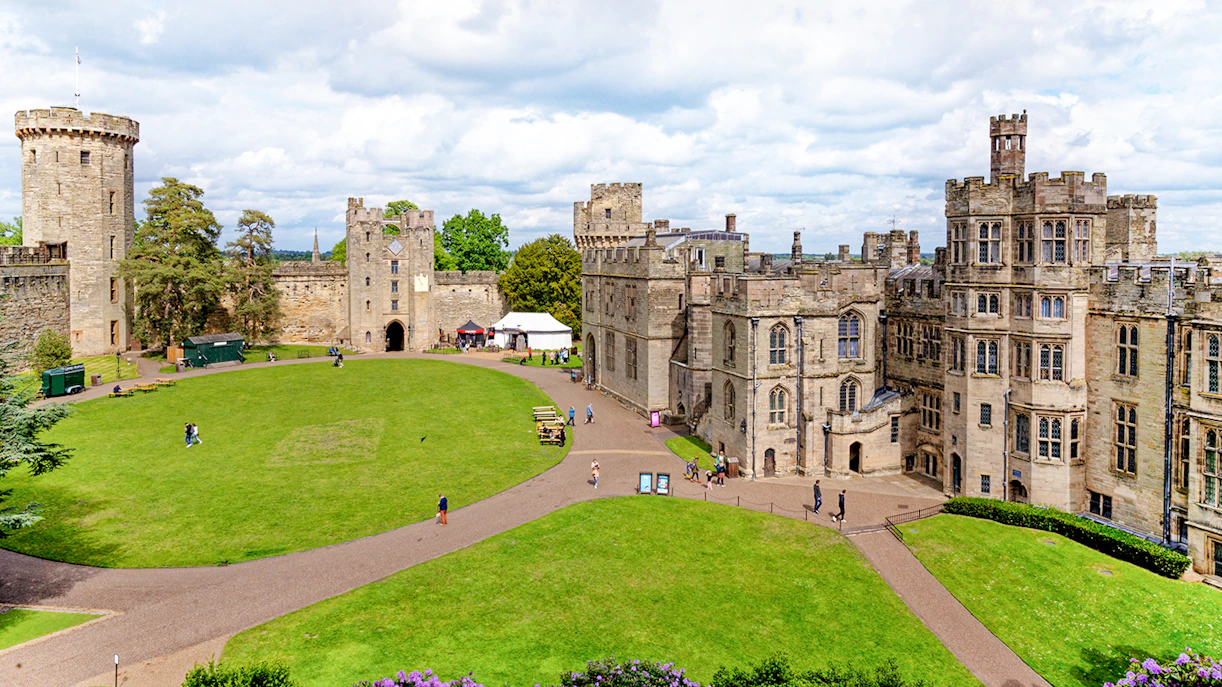
Warwick Castle sits on a sandstone bluff above the River Avon, a position the river has eroded into a natural cliff that, along with the rock itself, formed part of the site's original defences. What began as an earthwork mound and timber palisade was rebuilt in stone during the 12th century, and the original Norman mound, known as the motte, still survives as the oldest visible feature on the site.
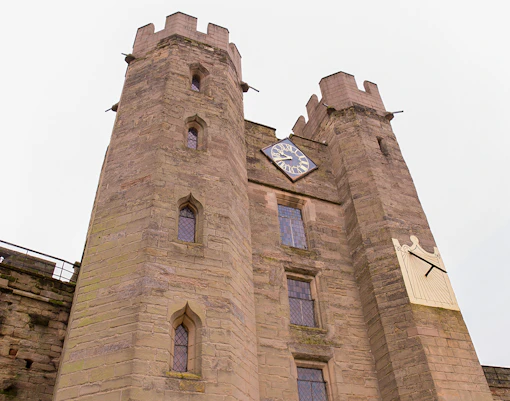
The castle's most recognisable architecture dates to the 14th century: Caesar's Tower and Guy's Tower, built with stone-vaulted interiors on every floor. Both towers feature machicolations, which are projecting stone galleries with openings in the floor that allowed defenders to drop objects on attackers below. The adjoining gatehouse added two drawbridges, a gate, and portcullises (heavy latticed barriers that could be dropped to block entry), along with murder holes, small openings used to attack anyone trapped in the entrance passage.
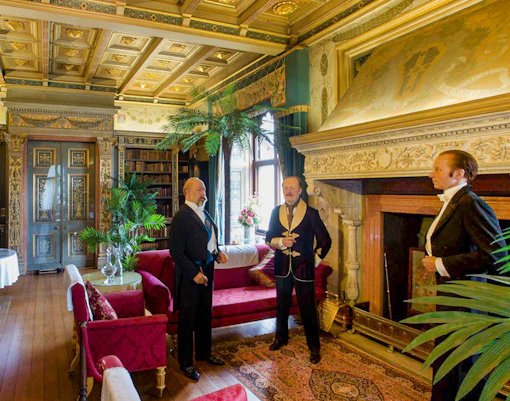
The castle's grounds were later reshaped by landscape designer Capability Brown, giving the fortress a more naturalistic, parkland setting. After a serious fire gutted the Great Hall in 1871, architect Anthony Salvin oversaw its reconstruction, restoring the room to its historic appearance. Together, these layers of mediaeval defence, Georgian landscaping, and Victorian restoration are what you'll see when you walk through the castle today.
Warwick Castle today — Why it matters
Step inside nearly 1,000 years of history
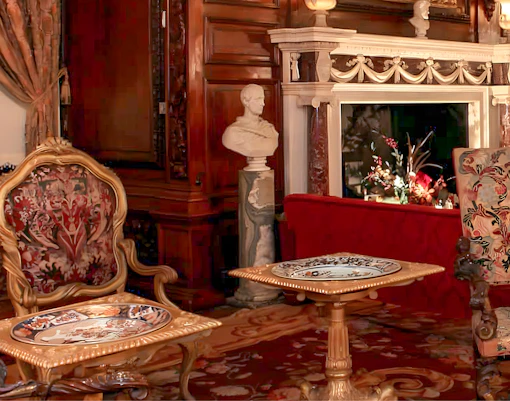
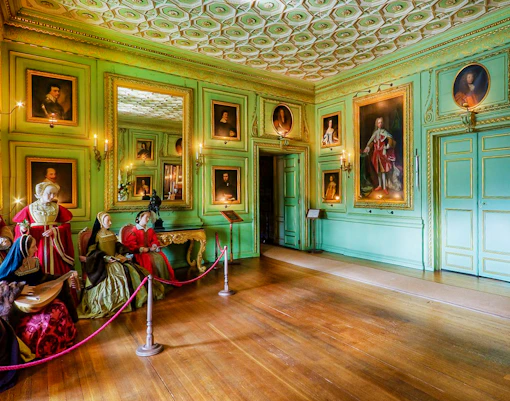
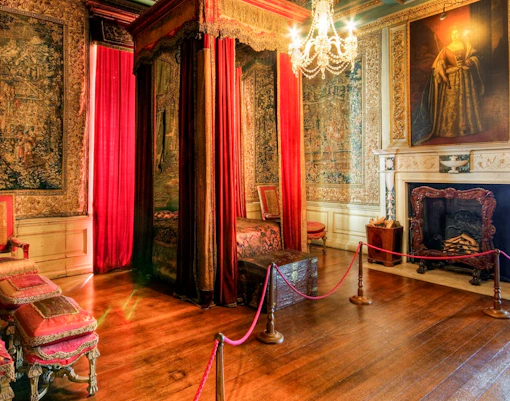
Admiring Warwick Castle from the outside is free, but upgrading lets you walk through nearly 1,000 years of history in person. Climb Guy's Tower for sweeping views over Warwickshire, wander the Great Hall and state rooms, and stand inside the dungeon beneath Caesar's Tower, where a king was once held prisoner during the Wars of the Roses.
Frequently asked questions about Warwick Castle's history
Warwick Castle was originally built in 1068 by William the Conqueror as a wooden motte-and-bailey fortress, part of his strategy to control the Midlands after the Norman Conquest.
It was built as a military stronghold to help the Normans assert control over a newly conquered England, particularly to safeguard the Midlands and a key stretch of the Fosse Way Roman road.
Few English castles have stayed continuously occupied and altered for nearly 1,000 years. Warwick Castle witnessed mediaeval sieges, a royal imprisonment during the Wars of the Roses, a Civil War siege, and a transformation from fortress to country house, making it one of the most complete examples of English castle history still standing.
It evolved from a wooden Norman fort into a stone shell keep in the 12th century, then into a heavily fortified mediaeval stronghold under the Beauchamp earls in the 14th century, before being converted into a country house by the Greville family from 1604 onwards. Today it operates as a major heritage attraction.
In 1469, Richard Neville, known as "the Kingmaker", imprisoned King Edward IV within Warwick Castle during his rebellion against the king, briefly making the castle the centre of English royal power.
Notable figures include William the Conqueror, who founded the castle; the Beauchamp earls, who built its iconic towers; Richard Neville, "the Kingmaker"; and Sir Fulke Greville, who transformed it into a country house in the early 17th century.
A fire deliberately started by a thieving under-butler destroyed the Great Hall and private apartments in December 1871. Architect Anthony Salvin led the restoration between 1872 and 1875, funded partly by public donations.
The original 1068 motte (earthen mound) still survives, along with the 14th-century Caesar's and Guy's Towers, the Great Hall, state rooms, and gatehouse. The castle remains a Grade I listed building and scheduled monument.
Kenilworth Castle, about 5 miles north, was a comparable mediaeval stronghold built around the same era, but it fell into ruin after being deliberately damaged during the Civil War. Warwick Castle, by contrast, has remained continuously occupied and largely intact, making it one of England's best-preserved mediaeval castles.