Planning your visit to Churchill War Rooms
Churchill War Rooms is a preserved World War II bunker and museum best known for the underground rooms where Churchill and his inner circle directed Britain’s war effort. The visit feels more intimate than big London museums, but the narrow corridors can bottleneck fast and the route is easier to enjoy if you know what not to miss. The biggest difference between a rushed visit and a good one is catching the Churchill Museum without having to double back. This guide covers timings, entry, route, and practical planning.
Quick overview: Churchill War Rooms at a glance
This is a timed-entry museum where planning your slot matters more than most visitors expect.
- When to visit: Monday–Sunday, 9:30am–6pm. The first hour after opening is noticeably calmer than 11am–2pm, because the narrow bunker route backs up quickly once tour groups and late-morning timed entries overlap.
- Getting in: From £34 for standard entry. Guided tours from £67. Advance booking is strongly recommended in summer, on school breaks, and for late-morning slots, but off-peak winter weekdays often still have short-notice availability.
- How long to allow: 1.5–2.5 hours for most visitors. It pushes to the longer end if you listen to the full audio guide and spend proper time in the Churchill Museum.
- What most people miss: The Churchill Museum turnoff and the tiny Transatlantic Telephone Room are the two easiest misses, partly because crowd flow pulls you forward through the bunker.
- Is a guide worth it? For most visitors, the included audio guide is enough; pay extra for a guided tour if you want the rooms sequenced and explained before the site gets crowded.
🎟️ Tickets for Churchill War Rooms sell out days in advance during summer and school-holiday periods. Lock in your visit before the time you want is gone.
Jump to what you need
🕒 Where and when to go
🗓️ How much time do you need?
🎟️ Which ticket is right for you?
🏛️ What to see
♿ Facilities and accessibility
Where and when to go
How do you get to Churchill War Rooms?
Churchill War Rooms is in Westminster, a 5-minute walk from Parliament Square and roughly 1 mile from Charing Cross in central London.
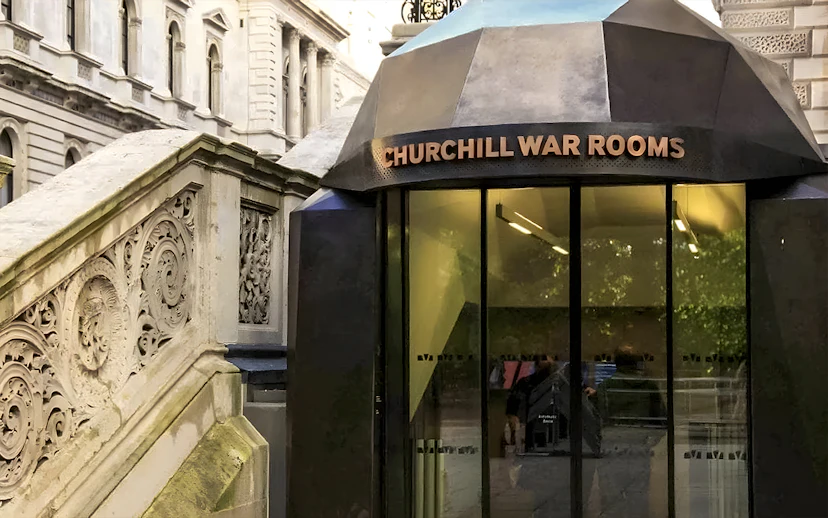
Clive Steps, King Charles Street, London SW1A 2AQ, United Kingdom → Open in Google Maps
- Metro: St. James’s Park station → 5-minute walk → best option on the District and Circle lines via Broadway exit.
- Metro: Westminster station → 8–10-minute walk → easiest if you’re already near Big Ben or the South Bank.
- Bus: Whitehall and Parliament Square stops → 5-minute walk → useful if you’re combining the visit with Westminster Abbey or Trafalgar Square.
- Taxi/rideshare: Drop-off on Horse Guards Road or Great George Street → short flat walk → easier than driving in this part of Westminster.
Which entrance should you use?
There is one main entrance at Clive Steps, but the queue splits by how you’re entering, and walk-up visitors are the ones most likely to lose time here.
- Pre-booked tickets: For timed-entry ticket holders. Expect 5–15 minutes during late morning, weekends, and school holidays.
- Walk-up tickets: For same-day buyers. Expect 20–45 minutes in summer, with no guarantee of the next available slot.
- Accessible entry: For step-free visitors. Staff can assist with lift access, but allow a few extra minutes at arrival.
When is Churchill War Rooms open?
- Monday–Sunday: 9:30am–6pm
- Last entry: 5pm
- December 24–26: Closed
When is it busiest? Late mornings and early afternoons from May to August, plus Easter, October half-term, and December 26–31, when the first bunker rooms feel slowest to move through.
When should you actually go? The 9:30am–10:30am slots on a weekday give you the best chance of seeing the Cabinet Room and Map Room before the route starts bunching up.
💡 Pro tip: The first timed slot is worth more here than at most museums because the route is so narrow — by 11am, even an on-time entry can still mean stop-start pacing inside the first rooms.
How much time do you need?
| Visit type | Route | Duration | Walking distance | What you get |
|---|---|---|---|---|
Highlights only | Entrance → Cabinet Room → Map Room → Churchill’s Office-Bedroom → exit | 1.5–2 hours | ~0.8km | You’ll cover the rooms most people came for, but you’ll skim past the Churchill Museum and miss the quieter end sections that make the bunker feel lived-in. |
Balanced visit | Entrance → main War Rooms route → Transatlantic Telephone Room → Churchill Museum → kitchen and canteen → exit | 2–2.5 hours | ~1km | This gives you the preserved bunker and enough Churchill context to make the rooms more meaningful, without trying to absorb every display in the museum. |
Full exploration | Entrance → full bunker route with audio guide → Churchill Museum timeline and speeches → final service rooms → gift shop and café | 2.5–3 hours | ~1.2km | This is the best version if you care about detail, but the trade-off is mental fatigue rather than distance — labels, audio, and close quarters add up by the end. |
The highlights and balanced routes work on the Churchill War Rooms Entry Ticket. Full exploration also fits that ticket.
✨ The full route is harder without context because the side rooms are easy to pass and the Churchill Museum turnoff is not especially intuitive. The Secrets of Churchill’s War Rooms tour makes the sequence clearer and adds the stories that short room labels can’t.
Which Churchill War Rooms ticket is best for you
| Ticket type | What's included | Best for | Price range |
|---|---|---|---|
Churchill War Rooms Entry Ticket | Timed entry + Cabinet War Rooms + Churchill Museum + audio guide | A first visit where you want the full site at your own pace and don’t need a live guide to structure it for you. | From £34 |
The Secrets of Churchill’s War Rooms | Early entry + expert guide + 90-minute guided tour + continued admission after the tour | A visit where you want the bunker before it fills up and want the rooms connected into a clear wartime story. | From £67 |
Wartime Westminster Walking Tour + Churchill War Rooms | Guided WWII Westminster walk + timed entry to Churchill War Rooms | A half-day plan where you want London’s above-ground wartime context before seeing the bunker itself. | From £75 |
London Pass/Go City Explorer Pass | Churchill War Rooms entry + access to other London attractions | A sightseeing-heavy London itinerary where War Rooms is one stop among several and the pass already makes financial sense. | From £85 |
How do you get around Churchill War Rooms?
Layout and route
The layout is compact and mostly linear: you move through the preserved bunker corridors first, then into the larger Churchill Museum before reaching the final service rooms and exit. In practice, that means it’s easy to self-navigate, but also easy to miss small side spaces or accidentally rush into the museum without finishing the bunker properly.
- Cabinet War Rooms corridor → Cabinet Room, Map Room, staff offices → allow 30–40 minutes.
- Churchill suite → office-bedroom, Chiefs of Staff area, telephone room → allow 15–20 minutes.
- Churchill Museum → interactive timeline, speeches, personal artefacts → allow 30–45 minutes.
- Service end of route → kitchen, canteen, exit displays, shop → allow 10–15 minutes.
Suggested route: Do the preserved bunker rooms slowly first, then the Churchill Museum, because most visitors who jump into the museum too early end up backtracking through the busiest corridor.
Maps and navigation tools
- Map: Entrance orientation signage is your best quick overview → it helps you spot where the bunker route gives way to the Churchill Museum → take a phone photo before descending.
- Signage: Main wayfinding is good enough for the one-way route, but not good enough for the museum turnoff and smaller side spaces if you’re moving with the crowd.
- Audio guide/app: The included audio guide is available in 8 languages → it works as both interpretation and route support → it adds far more value here than going fully self-guided.
💡 Pro tip: Stay alert for the Churchill Museum turnoff rather than assuming it comes after the exit sequence — plenty of visitors reach the end of the bunker, then realise they’ve skipped a major part of the visit and have to double back.
Where are the masterpieces inside Churchill War Rooms?

Cabinet Room
Era: 1940–1945
This is the bunker’s defining space: the room where Churchill and the War Cabinet met during the Blitz and weighed decisions that affected the entire war. What makes it worth slowing down for is not its size but its restraint — the table, papers, and Churchill’s chair make the pressure feel unnervingly ordinary. Many visitors glance, listen, and move on too quickly instead of noticing how small and improvised the room really is.
Where to find it: Early on the main bunker route, just after you enter the preserved War Rooms section.
Map Room
Era: 1939–1945
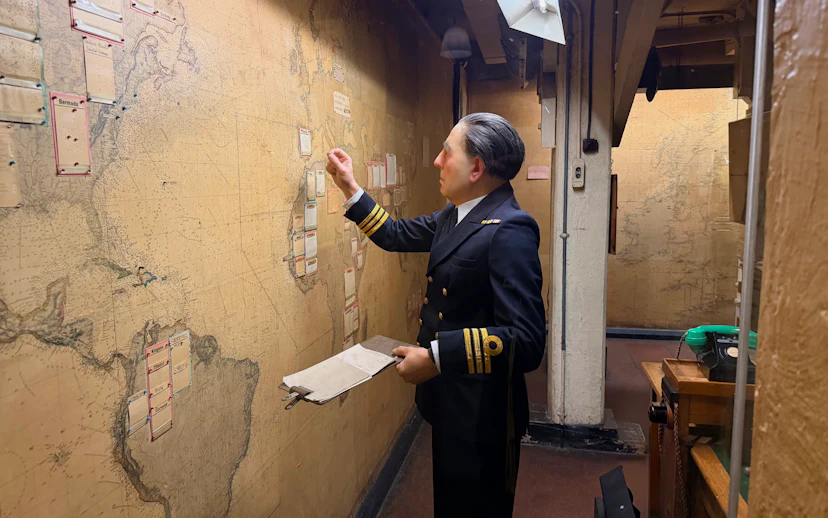
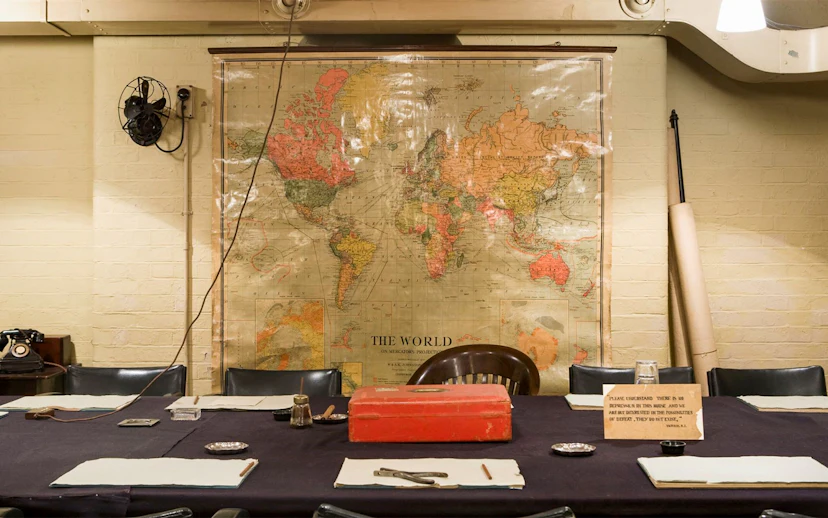
The Map Room is the most complete time capsule in the building, left much as it was when staff switched off the lights in August 1945. Slow down for the wall maps, pins, strings, and desks with telephones and signal lights — they show how intelligence was processed in real time, not just displayed afterward. The detail most people miss is the date still left on the wall calendar, which quietly fixes the room in its final wartime moment.
Where to find it: On the main bunker route, shortly after the Cabinet Room.
Churchill’s Office-Bedroom
Era: 1940–1945
This small room matters because it strips away the myth and shows the practical reality of leadership underground: a desk, a narrow bed, and work packed into tight space. It’s worth pausing here because it makes Churchill feel less like a statue and more like someone living on broken sleep in a bunker. Many visitors rush the doorway and miss the siren suit connection and how modest the room actually is.
Where to find it: Just beyond the Map Room area, beside the Churchill suite rooms.
Transatlantic Telephone Room
Era: 1940s communications
This cupboard-sized room is easy to miss and disproportionately memorable once you spot it. Its false ‘Private WC’ label tells you almost everything about the secrecy of the bunker, and the secure line to Roosevelt turns a tiny side room into one of the sharpest reminders of wartime improvisation. Most visitors walk straight past because the room is so small and the corridor flow keeps pulling them forward.
Where to find it: Along the corridor near Churchill’s office-bedroom.
Churchill Museum timeline
Era: Churchill’s life, 1874–1965
The Churchill Museum shifts the visit from room-by-room atmosphere to biography, and it’s where the site becomes much richer than a bunker tour. The long interactive timeline and speech displays help explain why Churchill mattered before and after the war, not just during it. Many visitors give this section too little time because they assume the preserved rooms are the whole experience, but this is where the wider context clicks.
Where to find it: Off the main War Rooms route, in the larger museum space after the preserved bunker rooms.
Kitchen and canteen
Era: Wartime daily life
The kitchen and canteen are quieter than the headline rooms, which is exactly why they’re worth a closer look. They show how routine life carried on underground — hot meals, tea, cooking equipment, and small acts of normality in an abnormal place. Most people hurry through because interpretation is lighter here, but these spaces do a lot to make the bunker feel inhabited rather than staged.
Where to find it: Near the end of the route, after the Churchill Museum and later bunker rooms.
💡 Don't leave without seeing: the Churchill Museum turnoff and the Transatlantic Telephone Room — one is easy to skip because the route flow keeps pulling you forward, and the other is so small that many visitors pass it before realising what it is.
Facilities and accessibility
- 🚻 Restrooms: Restrooms are available near the entrance and café, so it’s smartest to use them before descending or at the very end of the route.
- 🍽️ Café: There is an on-site café at the end of the visit, and it works better as a post-visit pause than a mid-visit break because re-entry is not allowed once you leave.
- 🛍️ Gift shop/merchandise: The gift shop sits near the exit and focuses on Churchill, wartime Britain, and Imperial War Museums souvenirs rather than generic London merchandise.
- 🪑 Seating/rest areas: The easiest place to sit properly is near the café and museum end of the route, because the preserved bunker corridors are built more for moving and stopping briefly than resting.
- 🎧 Audio guide: Every ticket includes an audio guide in 8 languages, picked up at entry, and it is a core part of how most visitors navigate and understand the site.
- ♿ Mobility: Step-free access is available via a lift at the entrance, and the main route is mostly accessible, though some corridors are narrow and a few smaller side areas are harder to enter comfortably.
- 👁️ Visual impairments: The included audio guide adds useful spoken context, but the experience remains highly visual because so much meaning sits in the preserved rooms, maps, and object detail.
- 🧠 Cognitive and sensory needs: The bunker is dim, enclosed, and can feel crowded or noisy when timed slots bunch up in the first rooms, so the calmest option is the first weekday entry.
- 👨👩👧 Families and strollers: Older children and teens usually get more from the visit than toddlers do, and narrow corridors mean strollers are less convenient here than at a typical large museum.
This site suits older children and teens best, especially if they’re already curious about World War II, Churchill, or London history.
- 🕐 Time: 60–90 minutes is realistic with younger children, while interested teens can comfortably do the full 2 hours if you keep the focus on the bunker rooms first.
- 🏠 Facilities: Restrooms and the café are the most useful family facilities here, but this is not a play-based museum and there are limited spaces for kids to burn off energy.
- 💡 Engagement: Start with the Map Room and Churchill’s bedroom before the Churchill Museum, because real rooms and objects usually hold children’s attention better than text-heavy displays.
- 🎒 Logistics: Bring a small bag, arrive close to your timed slot, and skip bulky strollers if you can, because the narrow route feels tighter once the late-morning crowd builds.
- 📍 After your visit: St. James’s Park is the easiest nearby reset, with open space and a much-needed contrast to the enclosed bunker atmosphere.
Rules and restrictions
What you need to know before you go
- Entry requirement: You need a timed-entry ticket, and if you arrive late, you may need to wait for the next available opening rather than entering immediately.
- Bag policy: Large luggage is not permitted, and all bags are screened at security, so a small day bag gets you inside faster.
- Re-entry policy: Re-entry is not permitted, which means you should handle restrooms, café timing, and gift-shop browsing before you leave the building.
Not allowed
- 🚫 Food and drink: Food and open drinks are best kept for the café area rather than the exhibition route through the bunker.
- 🚬 Smoking/vaping: Smoking and vaping are not permitted inside the museum spaces.
- 🖐️ Touching exhibits: Do not touch original furniture, maps, or equipment, because many objects are preserved in place as part of the historic bunker setting.
Photography
Photography is allowed in Churchill War Rooms for personal use, but flash, tripods, and selfie sticks are best avoided in the tight bunker spaces. The practical distinction is less about separate rooms and more about crowd flow: in narrow spaces like the Map Room or Churchill’s bedroom, quick photos work better than stopping for long setups. If staff temporarily hold visitors at a bottleneck, follow their direction before taking pictures.
Good to know
- The Churchill Museum is part of your ticket, but internal wayfinding is not perfect, so don’t assume the main bunker route automatically shows you everything without attention.
- Walk-up visitors wait behind pre-booked timed entries, so buying in advance is the closest thing this site has to true skip-the-line access.
⚠️ Re-entry is not permitted once you exit Churchill War Rooms. Plan restroom stops, meals, and rest breaks before leaving — the nearest cafés outside are back toward Parliament Square or St. James’s Park, about a 5–10 minute walk away, and getting back into the next timed slot can cost much more time at midday.
Practical tips
- Book 3–7 days ahead if you want a late-morning summer slot; in quieter months, 24–48 hours ahead is usually enough, but arriving late for your timed entry can mean waiting for the next gap.
- Save your concentration for the Map Room and Churchill Museum, because those are the two parts that reward lingering most; the kitchen and canteen are quicker to cover at the end.
- The best crowd-management move here is not just ‘go early’ but ‘go first thing on a weekday,’ because the bunker’s narrow route feels far more crowded once multiple timed entries compress into the same first rooms.
- Bring a small bag and leave bulky shopping elsewhere, since security screening is unavoidable and there is no practical advantage to carrying extras through tight corridors.
- Eat before you go down or wait until the end, because the café works well as a post-visit stop and single-entry rules make mid-visit food breaks a poor trade for the time you lose.
- If you only have 90 minutes, do the preserved War Rooms first and the Churchill Museum second; the biggest mistake is spending too long early on interactive displays and rushing the historic rooms later.
What else is worth visiting nearby?
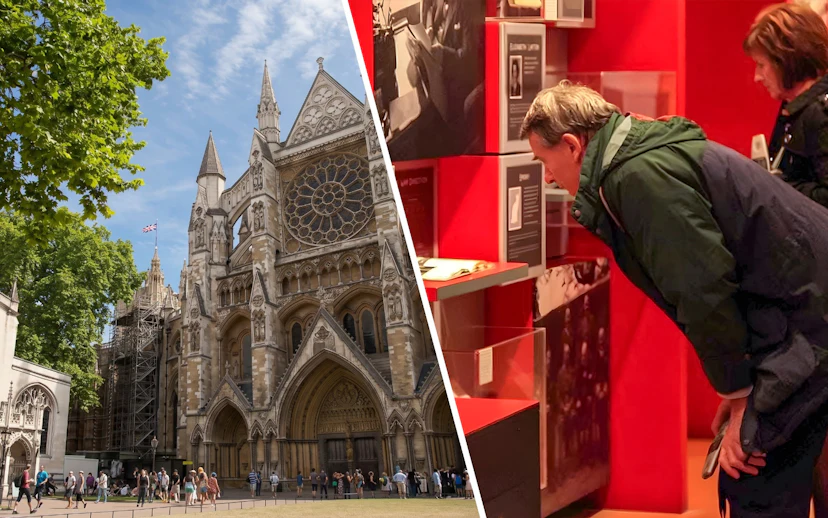
Commonly paired: Westminster Abbey
Distance: 450m — 6-minute walk
Why people combine them: They sit almost side by side in Westminster, so it’s an easy same-day pairing if you want one political-history stop and one royal-and-religious-history stop.
→ Book
Commonly paired: Houses of Parliament
Distance: 600m — 8-minute walk
Why people combine them: The pairing makes practical and thematic sense — Churchill’s wartime nerve centre below ground, and Britain’s parliamentary life above ground, all within the same neighbourhood.
Also nearby
St. James’s Park
Distance: 350m — 5-minute walk
Worth knowing: This is the best nearby decompression stop after the bunker, especially if you want fresh air and a slower pace before your next sight.
Buckingham Palace
Distance: 1.1km — 15-minute walk
Worth knowing: It’s an easy walk through St. James’s Park, so it works well if you want to turn a museum visit into a wider Westminster sightseeing loop.
Eat, shop and stay near Churchill War Rooms
- On-site: The on-site café is convenient for a tea or light bite after the visit, but it makes more sense as a fallback than a destination meal.
- Cellarium Café & Terrace (6-minute walk, Westminster Abbey precinct): British café fare in a historic setting, and one of the easiest nearby sit-down options if you want lunch right after the museum.
- The Red Lion (8-minute walk, 48 Parliament St): Classic pub food at Westminster prices, but useful if you want something hearty without straying far from Parliament Square.
- Regency Café (12-minute walk, 17–19 Regency St): Old-school London café food at a friendlier price point, and a better value pick than most spots immediately around Whitehall.
💡 Pro tip: Eat either before your timed slot or after you’ve finished — the no re-entry rule makes a mid-visit food stop more expensive in time than it looks.
- Churchill War Rooms gift shop: Best for Churchill books, wartime posters, and Imperial War Museums merchandise, and it’s the most relevant stop if you want a souvenir tied to the visit.
- Westminster Abbey Shop: Useful for gifts and London-themed keepsakes if you’re pairing both sites, and it’s only a short walk away.
Westminster is excellent if you want to walk to major sights and keep logistics minimal for a short London stay. It is not the most atmospheric part of London after dark, and hotel prices tend to run high for what you get. If your priority is convenience over neighborhood character, it works well.
- Price point: This area skews expensive, especially on weekdays and around Parliament, with fewer genuinely good-value hotels than Victoria or the South Bank.
- Best for: A short stay where you want Churchill War Rooms, Westminster Abbey, Big Ben, and St. James’s Park within easy walking distance.
- Consider instead: Covent Garden and the South Bank give you a livelier evening base, while Victoria often works better if you want slightly easier pricing without losing Westminster access.
Frequently asked questions about visiting Churchill War Rooms
Most visits take 1.5–2.5 hours. If you move briskly through the bunker and focus on the headline rooms, 90 minutes can work, but allowing 2 hours gives you time for the Churchill Museum as well. Visitors who listen to the full audio guide and read more labels often stay closer to 3 hours.
Yes, booking in advance is the safer choice, especially for summer, weekends, and late-morning slots. Walk-up tickets do exist, but pre-booked timed entries get priority and same-day visitors can end up waiting for whatever capacity remains. In winter on weekday mornings, short-notice tickets are usually easier to find.
Yes, but at this site ‘skip-the-line’ mostly means pre-booking a timed ticket rather than buying a special fast-track product. The real queue to avoid is the walk-up line and the wait for the next available slot. If you already have timed entry, you’ve solved most of the problem.
Arrive about 10–15 minutes early. That gives you enough time for bag screening and ticket checks without standing around too long outside. If you arrive much later than your slot, staff may move you to the next available opening instead of letting you enter straight away.
Yes, a small bag or backpack is fine, but large luggage is not allowed. All bags go through security, and bulky items slow entry and make the narrow bunker route more awkward once you’re inside. If you’re sightseeing all day, travel lighter here than you would for a big open museum.
Yes, personal photography is generally allowed. Flash, tripods, and long photo stops are the things most likely to cause problems, especially in tighter rooms like the Map Room. The site works best for quick handheld photos rather than elaborate setups because the corridors stay busy.
Yes, groups can visit, but timed planning matters more than it does at larger museums. The route is narrow and the first rooms bottleneck easily, so large groups should book well ahead and expect a slower pace through the bunker than through the Churchill Museum. Guided group options are also available.
Yes, but it suits older children and teens much better than toddlers. The real rooms, phones, and maps are engaging, but the experience is still information-heavy and there are limited hands-on elements. Families with younger children usually do better with a shorter visit focused on the bunker rather than every museum display.
Yes, Churchill War Rooms is mostly wheelchair accessible, with step-free access via a lift. The main route can be done, and accessible restrooms are available, but some corridors are narrow and a few smaller side spaces are less comfortable to enter fully. It’s accessible, but not as open or easy to maneuver as a purpose-built modern museum.
Yes, there is an on-site café and plenty of options within a 5–12 minute walk. The best planning tip is to eat before you go down or after you finish, because re-entry is not permitted once you leave. Westminster Abbey, Parliament Street, and Victoria Street all have practical nearby choices.
Buy online in advance through an official or verified booking partner. That gives you a timed slot and avoids the uncertainty of the walk-up line. If you buy on the day at the entrance, you may still get in, but you’ll be waiting behind pre-booked visitors and your preferred time may already be gone.